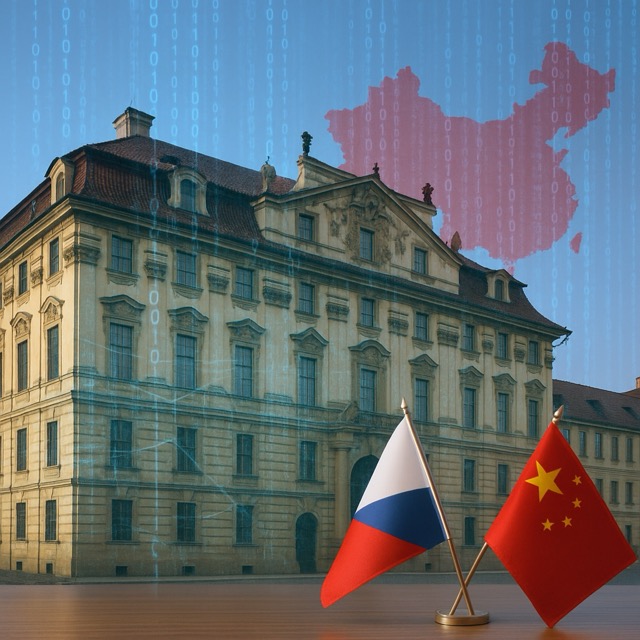
Why China’s APT31—Not Its North Korean Partners—Was Behind the 2025 Breach

On 28 May 2025 the Government of the Czech Republic publicly attributed a prolonged cyber‑espionage operation against the Ministry of Foreign Affairs (MFA) to Advanced Persistent Threat 31 (APT31). The group is widely believed to operate under the direction of China’s Ministry of State Security (MSS). Investigators revealed that APT31 maintained access to an unclassified diplomatic network from at least late‑2022, harvesting thousands of e‑mails and contact records. Classified systems were not breached, but the incident was nonetheless treated as an attack on critical infrastructure under Czech law.
The announcement reignited a persistent question in the cyber‑threat‑intelligence community: What, if any, role does North Korea play inside APT31? Some threat clusters that share code with APT31 have been linked to the Reconnaissance General Bureau (RGB) in Pyongyang. Analysts have therefore speculated about a Sino‑Korean co‑production model in which Beijing provides tooling and training while Pyongyang focuses on revenue‑generating heists. Could the breach in Prague have been a North‑Korean operation using Chinese resources as a false flag?
While intellectually tempting, that scenario does not fit the evidence collected by Czech investigators or by independent security vendors. This article examines the history of APT31, the limited overlap with North‑Korean actors, and the specific forensic findings that point squarely to Beijing as the driving force behind the 2025 intrusion.
APT31: a Sino‑Korean amalgam?
APT31—also catalogued as Judgment Panda, Violet Typhoon or Bronze Vinewood—entered public reporting in 2017. Its mandate appears primarily political: monitoring governments, NGOs and elections of strategic interest to China. Since 2021, however, a handful of implants originally written by APT31 developers have resurfaced in campaigns that bear North‑Korean hallmarks, including language artefacts, victimology focused on cryptocurrency exchanges, and compile‑time timestamps matching Pyongyang’s workday. Most experts interpret the pattern as code sharing or service leasing rather than full operational integration.
APT31 is believed to be connected to the Hubei State Security Department in Wuhan, China. It has used front companies such as Wuhan XRZ to conceal its cyber operations and has collaborated with other local entities for support. The group’s activities are part of a broader ecosystem where Chinese state security agencies outsource cyber operations to private contractors, blurring the line between official intelligence officers and hired hackers. The group has been observed using sophisticated tradecraft, such as sending emails disguised as legitimate news articles to gather reconnaissance data, and then launching tailored attacks based on the information collected.
There is overwhelming and consistent evidence from government investigations, indictments, and independent cybersecurity research that APT31 operates as a state-sponsored actor on behalf of the Chinese government, specifically the Ministry of State Security. The group’s operations align with China’s strategic interests, and its activities are enabled by a combination of intelligence officers and private contractors working under the direction or with the support of Chinese state security agencies.
Evidence that points to China
1. Infrastructure lineage: command‑and‑control (C2) domains recovered from Czech MFA logs were previously associated with APT31 waves targeting the Finnish Parliament (2020) and a Taiwanese referendum (2023). Certificates and WHOIS data showed no deviation from the Chinese clusters’ build pipeline.
2. Working hours & language: all payloads were compiled between 01:00 and 09:00 UTC—standard office hours in Beijing and Wuhan, but outside the regular RGB window. Debug strings and comments used simplified Chinese, not Korean.
3. Operational tasking: the threat actors pivoted into EU working groups on Ukraine reconstruction—an area of acute strategic interest for Beijing as it negotiates trade concessions with Brussels. No immediately obvious benefit accrues to Pyongyang.
4. Judicial corroboration: A March 2024 U.S. Department of Justice indictment named seven MSS officers as members of APT31; Czech investigators received mutual legal assistance confirming overlaps between those actors and IP addresses active in the Prague breach.
International response
Within 24 hours of the Czech announcement, the North Atlantic Council issued a statement of solidarity, calling the operation part of a ‘broader pattern of hostile cyber activities emanating from the People’s Republic of China.’ The European Union echoed the condemnation and hinted at coordinated sanctions should further aggression occur. The United States, United Kingdom and Australia, already bound together by 2024 sanctions against APT31 operators, renewed their travel bans and export‑control measures.
For its part, the Chinese embassy in Prague dismissed the attribution as ‘baseless’ and urged the Czech Republic to provide technical evidence—an oft‑repeated diplomatic script. North Korea made no public comment.
Why a North‑Korean false flag is unlikely
False‑flag operations are not unprecedented—Russia’s ‘Olympic Destroyer’ tried to frame DPRK in 2018—but they leave tell‑tale inconsistencies. In the Prague case no malware samples carried Korean language resources, no TTP matched known Lazarus or Kimsuky clusters, and the exfiltration servers were leased from a Chinese‑owned cloud provider. Absent such anomalies, investigators apply the principle of parsimony: the simplest explanation, direct Chinese control, prevails.
Lessons for attribution in 2025
The incident underscores how modern attribution rests on three pillars: (1) fine‑grained technical forensics that profile developer habits; (2) geopolitical context explaining the target’s value; and (3) legal processes that corroborate intelligence with courtroom‑grade evidence. Any theory contesting those pillars—such as a Korean hand in APT31—must meet an equally high evidentiary bar.
Conclusion
The 2025 breach at the Czech MFA highlights both the evolving sophistication of Chinese cyber‑espionage and the limits of Sino‑Korean collaboration. While tool reuse blurs actor boundaries, the Prague investigation demonstrates that careful forensic work can still disentangle shared code from operational control. For defenders, the message is clear: monitor the tactics, but always weigh them against motive and context. Only then can policy‑makers respond with precision and credibility.