How tighter rules for foreign students became a frontline tactic in Washington’s widening contest with Beijing
Introduction
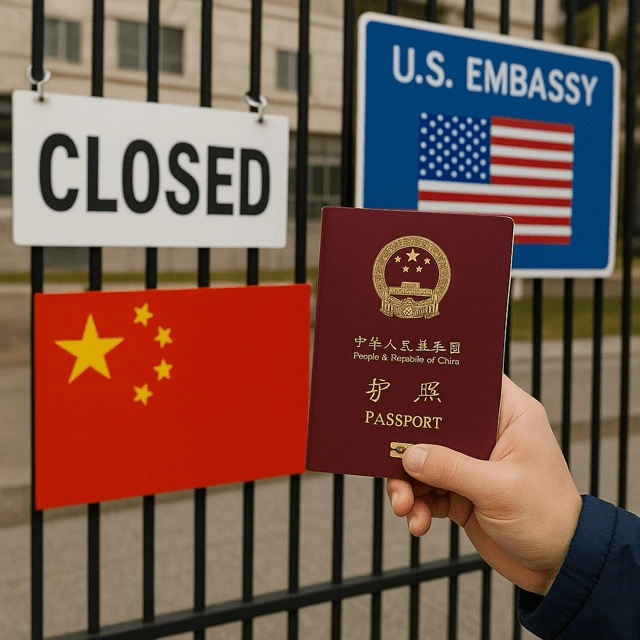
When the U.S. State Department quietly froze most student‑visa interviews on May 28 2025, the shock rippled from Beijing dorm rooms to Boston labs. Officials framed the pause as a security review, yet it followed months of incremental restrictions on F‑1 visas and new FBI vetting guidelines that single out applicants linked to Chinese universities with military partnerships. Critics say the real intent is geopolitical: to sever an academic artery that has long fed American science, tech and, by extension, soft power.
1. Bannon’s Blueprint
Former White House strategist Steve Bannon has pressed for years to use higher‑education access as leverage against Beijing. In an April broadcast of his “War Room” podcast, Bannon urged the administration to “immediately revoke all Chinese student visas,” arguing that U.S. universities have become conduits for technology theft.† He casts the move as part of a ‘total economic war’—tariffs, export bans and, now, academic exclusion—to force decoupling on terms set in Washington, not Beijing.
2. What the New Rules Do
Under guidance circulated this spring, consular officers must treat Chinese STEM applicants as presumptive national‑security risks unless they can prove no links to state research programs. A separate pilot caps F‑1 visas at four years—down from the previous maximum of five—and requires mid‑course renewals for scholars in “sensitive fields” such as quantum computing and AI. Embassies have also been told to ‘de‑prioritise’ interviews for nationals from the People’s Republic unless the applicant is funded by a U.S. institution.
3. The Numbers and the Money
Chinese enrolment at U.S. colleges has already fallen 28 percent since 2021. Harvard warned this month that further declines could cost the institution more than $120 million in tuition and research revenue.‡ Nationwide, international students contributed an estimated $40 billion to the U.S. economy last year. Yet Republican lawmakers behind the ‘Protect American Universities Act,’ introduced in March, call the revenue argument “a honey trap” that masks espionage risks.
4. China’s Counter‑moves
Beijing condemned the freeze as “academic McCarthyism” and vowed to expand scholarship programs at Australian, European and Asian universities. State media encouraged students to consider ‘friendlier’ destinations like Canada and Singapore, while hinting at retaliation against U.S. schools’ satellite campuses in Shanghai and Shenzhen.
5. Domestic Fault Lines
The White House’s right flank cheers the clampdown, linking it to broader immigration cuts. Tech CEOs and university presidents warn it undercuts America’s innovation edge, citing research that 54 percent of U.S. patents last year listed at least one foreign‑born inventor. Democrats are split: some fear anti‑Asian backlash; others see political upside in tightening borders ahead of 2026 midterms.
6. A Wider Strategy
Visa policy is rarely headline strategy, yet it dovetails with export controls on advanced chips, scrutiny of TikTok and new outbound‑investment reviews. “Each strand is non‑lethal alone,” one former National Security Council official notes, “but together they aim to constrict China’s capacity to leapfrog the West.” In that sense Bannon’s playbook has moved from fringe to framework, with student visas a surprisingly potent choke point.
Conclusion
For decades, American universities served as diplomatic back‑channels, educating generations of Chinese leaders and scientists. The new clampdown signals that Washington is willing to forgo that soft‑power dividend to wage what Bannon calls a ‘collateral‑damage war.’ Whether the strategy starves China’s tech rise—or starves U.S. labs of talent—may define the next chapter of the superpower rivalry.

 The Tower Post