Political and strategic tensions escalate from the battle‑scarred Donbas to Finland’s barbed‑wire lakes
Introduction
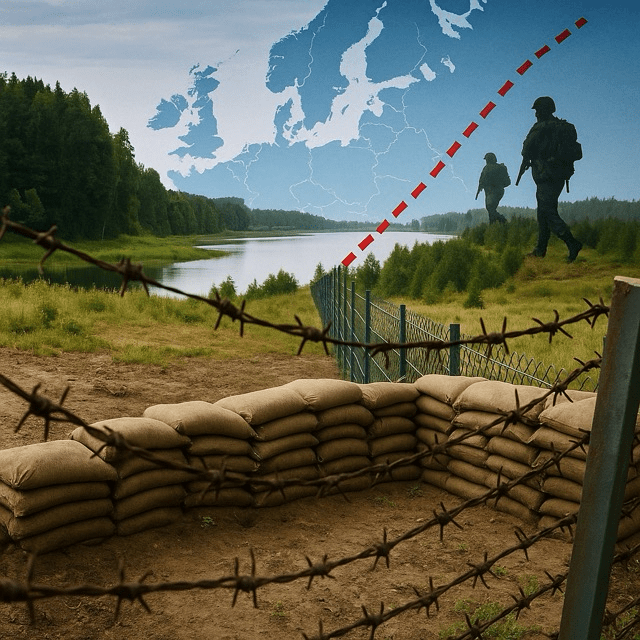
Europe’s eastern boundary is no longer a cartographer’s stroke but a combustible arc of bunkers, fences, and forward‑deployed brigades. From the shell‑ploughed steppes of eastern Ukraine to the pine‑rimmed lakes of Finland, Moscow’s war against Kyiv has reinvented what a frontier means. Where once the Iron Curtain divided ideologies, today trenches, drones, and concertina wire divide geopolitical wills. The past twelve months have witnessed an unmistakable escalation in both kinetic and hybrid confrontations, binding together distant segments of that frontier into a single, widening fault line.
1. Ukraine: A Drone‑Laden Front
On 26 May 2025, Russia launched the largest drone attack of the war—hundreds of Shahed‑type UAVs swarming Kyiv, Odesa, and Kharkiv during a single night. Ukraine’s air‑defence network intercepted most, but the barrage shattered apartment blocks and energy nodes, underscoring how the conflict has morphed into a contest of industrial endurance. The Kremlin portrayed the strike as retribution for Ukrainian cross‑border drone raids; Kyiv insisted it was a terror campaign aimed at eroding civilian morale. Whatever the narrative, the result is clear: the trench line running from Kupiansk to the Azov coast is a crucible whose heat radiates far beyond Ukraine’s borders.
2. The Baltic Shield: NATO Fortifies the North
Three NATO capitals—Tallinn, Riga, and Vilnius—spent the winter designing a joint ‘Baltic Defence Line,’ a decade‑long project of concrete bunkers, tank traps, and anti‑drone radars across 600 miles of frontier with Russia and Belarus. In January 2025, the Alliance activated Baltic Sentry, a standing maritime readiness force in the Gulf of Finland and Baltic Sea, aimed at deterring sabotage of undersea cables and pipelines. For the first time since the Cold War, German and Dutch brigades now exercise permanent rotations east of the Daugava River. Moscow brands the build‑up a provocation; NATO calls it guarding the seams of Europe’s security fabric.
3. Finland’s Frozen Gateway
If Ukraine is the hottest segment of the line, Finland is the newest. After abandoning decades of neutrality and joining NATO in 2023, Helsinki has moved with startling speed. Last week the Finnish Border Guard completed the first 35 km of a 4.5‑metre‑high fence near the Nuijamaa crossing—just a small slice of the 200 km barrier planned to deter weaponised migration and incursions. Motion sensors, night‑vision cameras, and rapid‑response units back the steel mesh. Further north, civil‑defence sirens now punctuate drills in university towns once better known for saunas than shelters. Satellite imagery shows Russia refurbishing its bases at Petrozavodsk and Kamenka, implying that Moscow also expects this boreal theatre to matter.
4. A Hybrid Front Line
Physical fortifications are only half the story. Across the frontier, hospitals have rehearsed ransomware scenarios; rail operators install jamming‑resistant signalling; Lithuanian divers guard fiber‑optic cables in the Narva estuary. In April, sabotage to a power substation in eastern Poland briefly cut electricity to NATO’s Suwałki Corridor—no group claimed responsibility, yet investigators traced malware signatures to servers used in previous Russian cyber operations. The Kremlin denies involvement, but the pattern of simultaneous probing—from drone fly‑bys over Estonian islands to deepfake videos of Latvian officials—maps a battlespace where bytes augment bullets.
5. Political Tremors West of the Line
The frontier’s escalation has re‑shaped domestic politics from Prague to Paris. European defence spending reached 2.21 percent of GDP on average this year, the highest in three decades, while polls show a majority of Swedes and Finns now favour permanent US troop rotations. Yet unity is brittle. In Hungary, Prime Minister Viktor Orbán rails against ‘war psychosis’; in Slovakia, populists question whether the Baltic build‑up invites rather than deters Russian aggression. The Kremlin courts these fissures with pipeline discounts and social‑media algorithms—another front in its long game.
Conclusion
From the black mud of Donbas to the snowy forests of Karelia, Europe’s divide with Russia is neither cold nor static; it is an ever‑shifting battleground of artillery duels, steel fences, and information fog. Each reinforcement along the line is a message: that the continent has learned from 2022 and will pay—in euros, in resolve, and if necessary in blood—to prevent another dawn of unravelling borders. Whether that resolve outpaces Moscow’s endurance will define Europe’s strategic climate long after today’s barbed wire rusts.


 The Tower Post