How the kingdom’s new state‑owned investment arm aims to reshape global artificial‑intelligence finance
Introduction
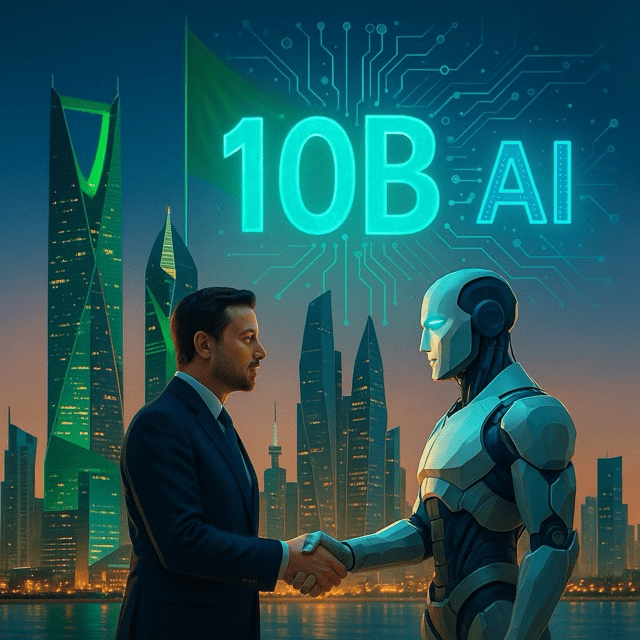
Saudi Arabia’s technology ambitions took another dramatic leap this week when Humain — the state‑owned artificial‑intelligence company backed by the kingdom’s $940 billion Public Investment Fund (PIF) — confirmed plans for a $10 billion venture capital vehicle. Dubbed **Humain Ventures**, the fund will target start‑ups in the United States, Europe and Asia, adding financial fire‑power to Riyadh’s long‑running campaign to pivot the oil economy toward data‑driven industries. The move follows a burst of multi‑billion‑dollar infrastructure deals with Nvidia, AMD and AWS, and signals that Crown Prince Mohammed bin Salman (MbS) now wants a seat at the cap‑tables of the AI companies themselves. citeturn0news10turn0search0
1. From PIF to Humain Ventures: How the Fund Is Structured
Humain is less than a year old, yet its mandate is expansive: build domestic compute capacity, develop Saudi‑designed chips and act as an AI deal‑clearing house for the Gulf. According to CEO Tareq Amin — the former Rakuten Mobile chief hired in January — Humain Ventures will be seeded directly from PIF’s balance sheet, making it one of the largest evergreen VC pools ever assembled. Early term‑sheets seen by the *Financial Times* suggest cheque sizes from $25 million Series A rounds to $500 million growth‑stage tickets, with a bias toward firms that can partner on Humain’s planned 6.6 GW network of data centres. citeturn0news10turn0search2
2. Strategic Drivers: Vision 2030 and Tech Sovereignty
Riyadh’s Vision 2030 blueprint calls AI **“the new oil.”** Officials say the venture arm serves two goals: diversify sovereign wealth away from hydrocarbons and secure early access to intellectual property in generative models, robotics and quantum computing. Analysts note a geopolitical edge as well: owning stakes in Western AI champions could give Saudi negotiators soft power in future export‑control battles over advanced chips. The approach mirrors Abu Dhabi’s G42, but dwarfs it in scale. citeturn0search3turn0search7
3. Where the Money Will Flow
Humain is scouting U.S. coastal hubs, but also intends to back European firms hamstrung by capital‑markets fragmentation and Asian chip‑design houses in search of scale. Term‑sheet language emphasises **‘co‑location opportunities’** — meaning start‑ups that also rent Saudi compute at subsidised rates can expect sweeter valuations. Early targets include climate‑model spin‑offs, Arabic LLM developers and edge‑AI robotics for mining and logistics. Talks are reportedly under way with Andreessen Horowitz and SoftBank as potential co‑investors. citeturn0search0turn0search5
4. Global Reactions and Regulatory Hurdles
Washington has welcomed Gulf capital, but Humain’s scale could trigger scrutiny from the Committee on Foreign Investment in the United States (CFIUS), especially if deals touch dual‑use fields like autonomous drones. European regulators, meanwhile, see opportunity: Brussels is quietly courting Saudi money for its own AI Act compliance fund. Yet critics warn that sovereign stakes may politicise boardrooms and complicate export‑control enforcement.
5. Risks and Realities
The venture push lands as oil prices oscillate and megaprojects such as NEOM strain Saudi finances. Funding a $10 billion VC pot on top of a $77 billion data‑centre plan will test PIF’s liquidity. Talent is another bottleneck: despite liberalised visas, the kingdom remains a hard sell for senior AI researchers. Finally, venture success is probabilistic; even with deep pockets, the path from cheque to exit can be a decade long.
Conclusion
A decade ago, few imagined Riyadh as a venture‑capital powerhouse. Today, with Humain Ventures, Saudi Arabia is positioning itself as both a builder and a banker of the AI revolution. If the strategy works, Silicon Valley founders may soon pitch not just to Sand Hill Road but to King Abdulaziz Boulevard. If it falters, the lesson will be clear: in AI, money buys a ticket, not a guaranteed seat at the front of the train.



 The Tower Post