National‑security anxieties, tech‑espionage fears, and political optics converge in a controversial data‑collection push
Introduction
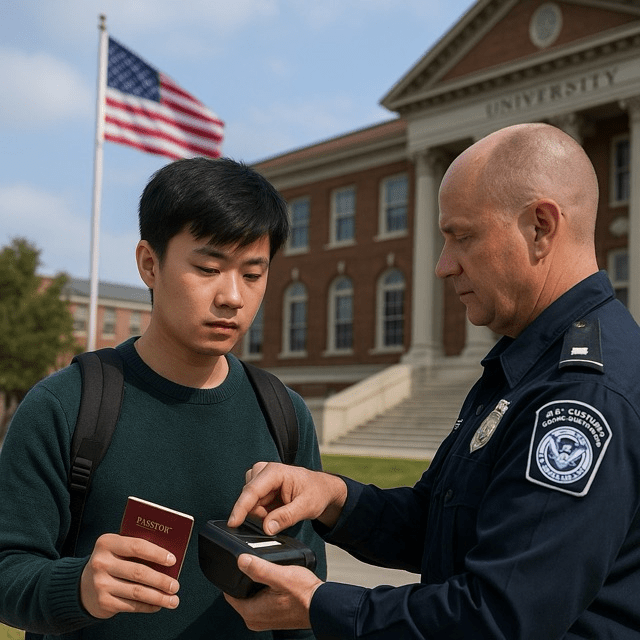
This spring the U.S. Department of Homeland Security floated a proposal that would require universities to upload expanded biometric and background data on every foreign student to a new federal clearing‑house. Supporters frame the move as a twenty‑first‑century upgrade to SEVIS, the post‑9/11 Student and Exchange Visitor Information System. Critics warn of a sweeping “digital dossier” that risks chilling academic exchange. Why does Washington want a master list now—and what might it mean for America’s role as a magnet for global talent?
1. A Security Legacy That Never Went Away
SEVIS already tracks more than one million active F‑1, J‑1, and M‑1 visa holders. Born in the wake of 9/11, the database records addresses, course loads, and employment status. Yet intelligence officials say gaps remain: schools self‑report changes, data fields are limited, and biometric checks are confined to visa issuance. The new proposal would capture facial scans at campus arrival, cross‑reference students with export‑control watch‑lists, and flag abrupt major changes—say, from English lit to nuclear engineering—for manual review.
2. The China Factor—and Beyond
Lawmakers from both parties cite a spike in economic‑espionage indictments, 74 percent of which involve Chinese nationals. The FBI warns that advanced research labs have become prime targets for AI, quantum, and hypersonics secrets. But the net is wider: the proposed rule would apply to all 200+ source countries, mirroring Australia’s Autonomous Sanctions Act after the AUKUS deal. Officials insist the system is country‑agnostic; civil‑rights groups see a dragnet that masks geopolitical rivalry.
3. What Data—and Who Holds It?
Draft documents suggest universities would collect fingerprint templates, DNA cheek swabs optional for sensitive‑tech students, and real‑time geolocation pings via campus Wi‑Fi. The data would reside on a DHS cloud tied to the National Counterintelligence and Security Center. Privacy advocates decry mission creep: ‘temporary visitors’ would become “permanent suspects.” Higher‑ed lobbyists worry about compliance costs and liability if data are hacked.
4. Political Optics in an Election Cycle
The Biden administration frames the registry as a calibrated security upgrade, yet timing matters: 2026 mid‑terms loom, and Republicans hammer the White House over spy‑balloon embarrassment and university protests. A tough stance on student visas offers bipartisan messaging points—protecting innovation, defending jobs—while avoiding the thornier terrain of corporate export compliance.
5. Allies and Precedents
Washington is not alone. The U.K.’s Academic Technology Approval Scheme already vets STEM students from ‘at‑risk’ countries. Canada’s new ‘National Security Lens’ for research funding implies a similar database. U.S. officials say harmonising standards prevents ‘forum shopping’ by hostile actors. Detractors reply that layered scrutiny will drive talent to the EU, which—Brexit aside—still leans on GDPR constraints.
6. Potential Blowback: The Talent Calculus
Universities fear a recruitment cliff. International students pumped an estimated $40 billion into the U.S. economy last year and filled 54 percent of STEM graduate seats. Surveys by QS show that 62 percent of prospective students would rethink U.S. applications if biometric tracking extends beyond visa issuance. Silicon Valley CEOs warn privately that America risks ‘slow‑motion decoupling’ from the human capital powering its start‑up engine.
Conclusion
The proposed all‑student registry sits at the crossroads of security realism and soft‑power pragmatism. Whether Congress green‑lights the plan in its current form—or tempers it with stronger privacy safeguards—will signal how the U.S. intends to balance innovation openness with national‑security vigilance in the years ahead. For now, the message to foreign scholars is clear: the welcome mat is still out, but so are the scanners.




 The Tower Post