Leveraging the Intellectual Legacy of the Wǔ‑sì Yùndòng for 21st‑Century Cultural Leadership
When Harvard scholar Joseph Nye coined the term “soft power” in the late 1980s, he had in mind the ability of a country to persuade and attract rather than coerce. For three decades the United States has led that domain through Hollywood, Silicon Valley, Ivy‑League universities, and an aura of liberal optimism. Yet the global information order is changing rapidly, and Beijing appears determined to fill any vacuum left by America’s inward turn. To understand how China might do so, one must look not only at its economic rise but also at its cultural wellspring—chief among them the May Fourth Movement of 1919.
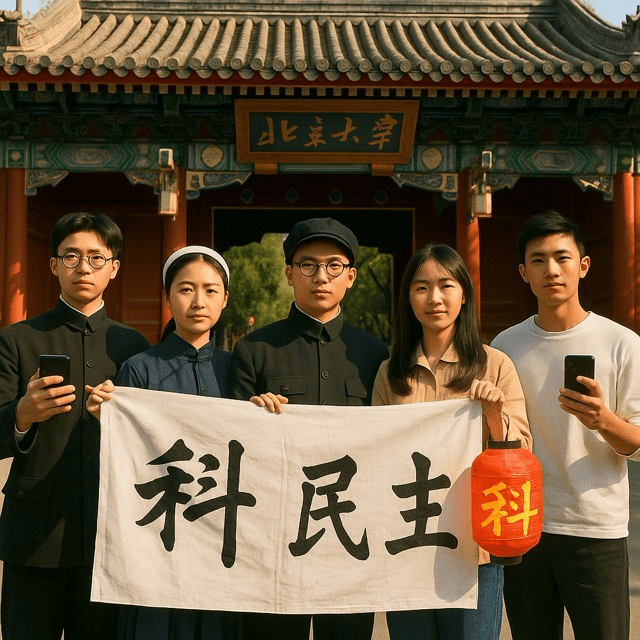
The May Fourth demonstrations began as a student protest against the Versailles Treaty’s transfer of Shandong to Japan, but the episode quickly blossomed into a nationwide call for “Mr. Science” and “Mr. Democracy.” The young intellectuals of Peking University rejected ossified Confucian hierarchies, embraced vernacular literature, and insisted that China’s future stature would be measured as much by ideas as by armies. A century later, those ideals offer ready‑made symbols for Beijing’s global messaging: anti‑imperial nationalism resonates in the Global South, while an ethos of self‑strengthening maps neatly onto current narratives of technological self‑reliance.
For the United States, soft power has long rested on three pillars: open academic exchange, entertainment media, and a story of continual self‑critique. China’s leadership recognizes that competing narratives require comparable assets. What the May Fourth legacy supplies is a domestic precedent for intellectual pluralism and cultural dynamism—qualities often assumed to be exclusive to liberal democracies. If articulated convincingly, that precedent could underwrite a Chinese brand of soft power that is less didactic than earlier propaganda and more aspirational to international audiences.
Equally important, the symbolism of youthful protest allows Beijing to present itself as a nation that listens to its passionate citizenry. In state discourse, May Fourth has morphed from a cautionary tale about foreign humiliation into a celebration of mass participation in national rejuvenation. That shift, if projected outward, could frame China as a partner sympathetic to anti‑colonial struggles worldwide. In an era when Western credibility is eroded by memories of Iraq and unchecked social inequality, a narrative anchored in anti‑imperial solidarity may prove especially attractive.
Translating historical symbolism into twenty‑first‑century influence, however, requires more than slogans. Beijing has already woven May Fourth themes into its flagship “Chinese Path to Modernization” campaign; the next step is to embed those themes across educational and cultural exchange. Enlarging scholarships for foreign students at Chinese universities, expanding joint laboratories on green technology, and sponsoring translation projects for Chinese vernacular literature can all channel the movement’s ethos of scientific inquiry and linguistic accessibility.
Digital platforms offer a second avenue. In Southeast Asia and Africa, short‑video apps such as TikTok and Kwai out‑perform Western competitors. Curating playlists that spotlight May Fourth literature, studio‑produced historical dramas, and user‑generated explainers on Chinese scientific milestones would reinforce the link between youthful creativity and China’s modern path. Crucially, these platforms thrive on algorithmic personalization; that flexibility allows Chinese cultural producers to highlight universal themes—youth empowerment, anti‑colonial dignity—while downplaying local controversies.
Infrastructure diplomacy under the Belt and Road Initiative (BRI) represents yet another channel. Confucius Institutes alone cannot carry the full weight of soft power; incorporating cultural centers into large BRI rail or port projects would embed May Fourth commemorations—exhibits, lecture series, maker‑spaces—directly within communities that benefit from Chinese investment. The fusion of tangible development with intellectual partnership could differentiate Beijing’s approach from Washington’s often rhetoric‑heavy assistance programs.
Challenges remain formidable. Genuine soft power cannot be commanded by state fiat; it must be earned through consistent openness. Heavy‑handed censorship, distrust over data security, and geopolitical frictions each dilute China’s appeal. Moreover, the historical May Fourth Movement was defined by its capacity to criticize authority—an uncomfortable reminder for today’s centralized governance. Balancing narrative control with authentic intellectual exchange will determine whether the legacy becomes an asset or a contradiction.
Policy recommendations therefore converge on credibility. Beijing could pilot a quota of uncensored foreign films on domestic streaming sites, invite international journalists to May Fourth commemorations, and empower private publishers to curate cross‑cultural anthologies without prior restraint. Such gestures would echo the original students’ demand for “realistic literature” and signal confidence in China’s cultural confidence.
In conclusion, the Wǔ‑sì Yùndòng supplies China with a historically grounded story of youthful vigor, scientific curiosity, and anti‑imperial autonomy. If deployed deftly, that story could rival the American dream in the global imagination. Whether Beijing chooses to embrace the movement’s spirit of open inquiry—or merely its rhetorical convenience—will determine if May Fourth truly becomes the cornerstone of a new Chinese soft power era.

 The Tower Post