A new inspection regime ends a two‑year import ban and could reboot US$1.4 billion in marine trade across the East China Sea
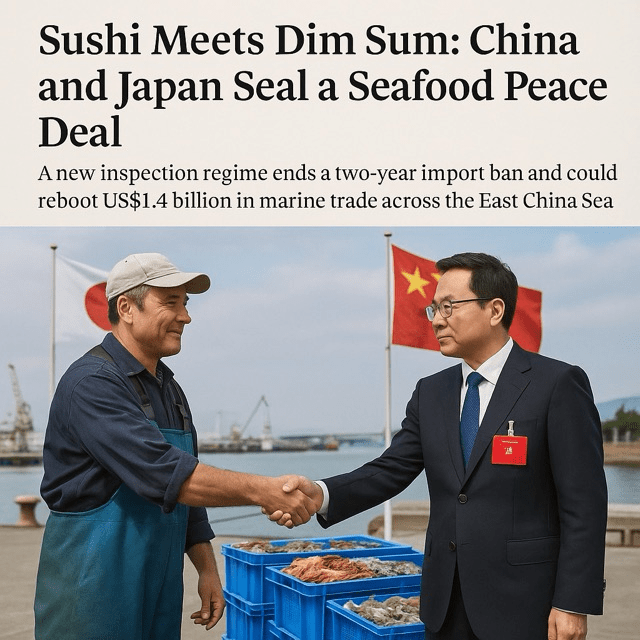
Shanghai / Tokyo, 31 May 2025 — Two years after Beijing halted imports of Japanese marine products in protest at the Fukushima wastewater discharge, the neighbours have cast their nets toward reconciliation. Officials from the Chinese General Administration of Customs and Japan’s Ministry of Agriculture, Forestry and Fisheries signed a fourteen‑page memorandum at Beijing’s Diaoyutai State Guesthouse, reopening one of Asia’s most lucrative seafood corridors.
The 2023 embargo slashed Japan’s seafood exports by almost a third and left cold‑storage warehouses overflowing with unsold scallops, sea cucumbers, and tuna. China justified the ban on public‑health grounds, despite International Atomic Energy Agency data showing tritium levels far below global thresholds. Tokyo countered that the move was a political lever disguised as science.
Under the new pact, every outbound shipment from Japan will carry a QR‑code “clean certificate” linking to a blockchain ledger of catch location, processing plant, and independent radionuclide readings. China, for its part, will staff a joint laboratory in Qingdao to cross‑check samples in real time, while Japan welcomes Chinese inspectors at ports in Hokkaido and Kyushu.
Economists estimate the accord could revive at least ¥200 billion (about US$1.4 billion) in annual trade and safeguard 15,000 jobs in Japan’s coastal prefectures. Chinese restaurateurs, facing a sashimi shortage that drove prices up 40 percent, celebrated the news; shares in leading seafood distributor Dalian Yihaijia jumped 6 percent on the Shanghai Stock Exchange.
Diplomatically, the deal arrives amid wider attempts to stabilise Sino‑Japanese ties as Washington and Brussels tighten technology controls on China. Analysts view the seafood accord as a low‑stakes confidence‑building measure that could pave the way for cooperation on climate adaptation and maritime search‑and‑rescue.
Implementation will roll out in three phases. From 15 June, live shellfish and finfish harvested outside the Fukushima region may enter Chinese ports. By October, processed products—dried kombu, bonito flakes, and canned mackerel—are due for clearance, pending audit results. If cesium levels in marine sediment remain below jointly agreed thresholds, limited imports from Fukushima itself could resume in early 2026.
Reaction in Japan’s fishing towns was immediate. At Hachinohe harbour, auction bells rang as brokers booked advance orders; in Kushiro, scallop farmers who had been forced to freeze inventory discussed chartering additional reefer ships. “This is oxygen,” said Takashi Watanabe, president of the National Federation of Fisheries Cooperatives. “But we need predictability—one more shutdown would be fatal.”
Consumers in China greeted the hashtag #SeafoodPeace with 120 million views on Weibo within six hours. While many users welcomed cheaper sushi, a vocal minority accused Beijing of bowing to foreign pressure. State media sought to reassure the public, emphasising the stringency of the new testing regime and broadcasting footage of Chinese inspectors wielding Geiger counters on Japanese docks.
Environmental NGOs offered measured praise. Greenpeace East Asia called the transparency gains “significant” but warned that long‑term ecological impacts of the Fukushima discharge remain uncertain. The International Atomic Energy Agency welcomed the pact while urging both governments to release raw monitoring data to international researchers.
If the first consignments clear customs smoothly, diplomats hope the seafood rapprochement can broaden into cooperation on ocean‑acidification studies and joint patrols against illegal fishing. For now, chefs in Guangzhou and Ginza are sharpening their knives: proof that, in the right conditions, even radioactive politics can make way for raw fish diplomacy.




 The Tower Post