Investigating the crash of Flight AI-787 and the suspected shadow of espionage
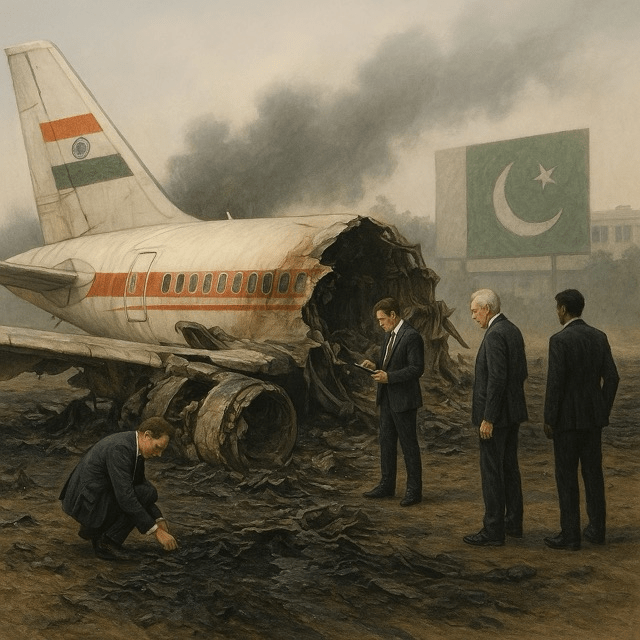
On a fateful morning in late May 2025, Air India Flight AI-787, a brand-new Boeing 787 Dreamliner, departed from New Delhi en route to Mumbai. The flight carried 212 passengers and 16 crew members—among them business executives, diplomats, and tourists. Approximately thirty minutes after takeoff, as the aircraft cruised at FL350, the cockpit instruments signaled a catastrophic failure: the left engine had suffered an abrupt shutdown, followed by a cascade of system errors. Within seconds, the jet lurched violently and descended uncontrollably into the Thar Desert, leaving no time for distress calls. By the time rescue teams arrived, there were no survivors.
India’s aviation authorities, joined by Boeing engineers, launched a comprehensive investigation under the oversight of the Directorate General of Civil Aviation (DGCA). Initial findings ruled out mechanical defects or manufacturing flaws—a startling conclusion, given the Dreamliner’s impeccable safety record. The engine logs, preserved in the flight data recorder, indicated manual shutdown commands interspersed with abnormal voltage spikes in the wiring harness. These inconsistencies pointed not to accident but to deliberate sabotage.
Forensic analysis of the wreckage revealed traces of a rare industrial compound—diethyl phthalate—commonly used as a solvent in clandestine operations. While not inherently explosive, its presence on critical wiring assemblies suggested tampering with the aircraft’s electrical system. Investigators discovered small puncture marks on access panels near the engine control unit, consistent with covert insertion of chemical capsules designed to corrode wiring insulation over time. Combined with the engine logs, the evidence painted a disturbing picture: Flight AI-787 had been chemically compromised to trigger an in-flight shutdown.
As news of the sabotage emerged, speculation turned swiftly toward geopolitical adversaries. Tensions between India and Pakistan have long simmered over territorial disputes and proxy conflicts. Intelligence sources within Delhi whispered of ominous parallels to the 1985 bombing of Air India Flight 182, attributed to extremist militants. However, this time, the prime suspects were not non-state actors but elements within Pakistan’s Inter-Services Intelligence (ISI). Over the past year, Indian counterintelligence had intercepted communications suggesting that Pakistani operatives had developed specialized chemical sabotage techniques for use in asymmetric warfare.
Senior Indian intelligence officials, speaking on condition of anonymity, revealed that the ISI had recruited disaffected aviation technicians in the subcontinent and provided them with encryption tools and tradecraft training. The network reportedly smuggled chemical payloads into Mumbai’s maintenance facilities, where the saboteurs had secured brief access to the grounded Dreamliner days before the crash. Their method mimicked a timing device: chemical corrosion that would degrade critical insulation only moments after engine startup at altitude.
New Delhi promptly lodged a formal protest with Islamabad, demanding transparency and cooperation. Pakistani authorities, for their part, dismissed the allegations as “baseless and politically motivated,” promising a “thorough inquiry.” Yet, leaked diplomatic cables obtained by the press painted a less conciliatory picture: senior ISI officials were said to have discussed the operation’s logistics, celebrating its potential to inflict damage on India’s strategic aviation capabilities. Such revelations have deepened mistrust and fueled calls for international intervention.
Amid the diplomatic storm, international bodies have taken notice. The International Civil Aviation Organization (ICAO) has dispatched experts to oversee the expanded probe, while aviation security agencies worldwide have issued alerts about similar chemical sabotage risks. Airlines have begun inspecting critical electrical components with chemical detection swabs, a precautionary measure expected to become standard protocol. Boeing has pledged cooperation and announced a forthcoming software update to detect unusual electrical anomalies that could signal tampering.
In India, public outrage has been profound. Families of the victims have demanded accountability not only from the Pakistani government but also from Indian security services, accusing them of lapses in maintenance oversight. Parliament convened an emergency session, leading to the formation of a Joint Parliamentary Committee on Aviation Security. Its interim report criticized the DGCA for inadequate vetting of maintenance personnel and recommended tighter control over hangar access at major airports.
Looking ahead, the AI-787 disaster underscores a new era in aviation threats—where state-sponsored sabotage can exploit technological vulnerabilities in the world’s most advanced airliners. It highlights the need for robust international cooperation, intelligence sharing, and the integration of chemical forensics into routine safety inspections. For India, the crash remains a stark reminder that modern warfare’s front lines can extend into the skies, demanding vigilance beyond traditional military domains. Only through coordinated effort and transparency can the global community hope to prevent such tragedies from recurring.



 The Tower Post