Assessing the dynamics, strategies, and outcomes of sustained air engagements
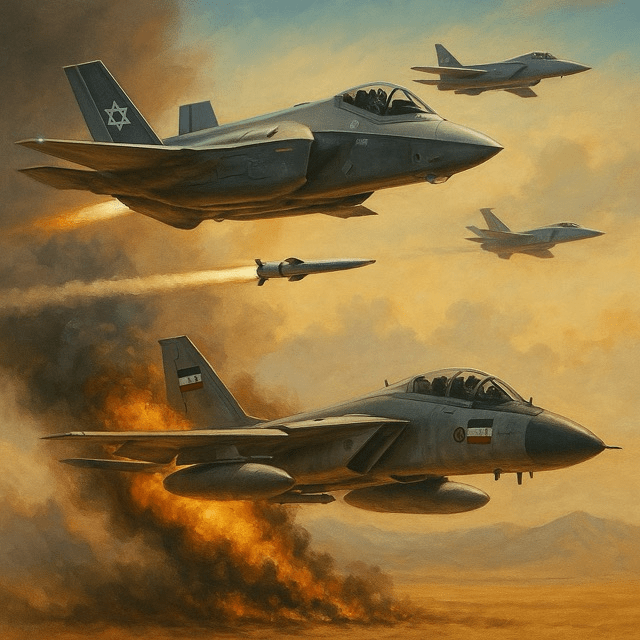
Since the breakdown of deterrence in the Middle East, an escalating aerial conflict between Israel and Iran has taken center stage. This war of attrition, fought primarily through airpower, drones, and missile strikes, reflects both nations’ strategic imperatives and technological proficiencies. Israel aims to degrade Iran’s military infrastructure and nuclear capabilities from the air, while Tehran seeks to retaliate via proxy-launched missiles and asymmetric drone swarms. As each side absorbs damage and adapts, the plausibility of a sustained air conflict raises critical questions about escalation, regional stability, and the prospects for de-escalation.
Israel’s air campaign leverages its highly trained air force, precision-guided munitions, and robust intelligence network. Early strikes have targeted Iranian air defense sites near the Gulf coast, long-range missile batteries in western Iran, and manufacturing facilities associated with ballistic missile development. By systematically dismantling Iran’s layered air defenses, the Israeli Air Force (IAF) creates corridors for subsequent sorties against deeper strategic targets—such as research centers believed to support Iran’s uranium enrichment.
Conversely, Iran has relied on a multi-tiered approach. The Islamic Revolutionary Guard Corps Aerospace Force (IRGC‑ASF) employs medium-range ballistic missiles and cruise missiles to strike Israeli military bases and critical infrastructure. Additionally, Iran has expanded its deployment of armed drones—particularly the Shahed series—launching coordinated salvos designed to overwhelm Israel’s Iron Dome and Arrow missile defenses. These drone waves serve dual purposes: inflicting damage and probing air defense weaknesses for future strikes.
A defining characteristic of this conflict is its gradual escalation. Both sides have demonstrated calibrated restraint to avoid a full-scale ground invasion or direct strategic bombing. Instead, they engage in tit-for-tat attacks: Israel retaliates for missile barrages by neutralizing drone launch sites in Iraq and Syria; Iran responds to Israeli strikes on its Lebanese proxies by targeting Israel’s Negev air bases with loitering munitions. This cyclical pattern of action and counteraction creates a sustained stalemate, undermining deterrence while preventing decisive breakthroughs.
Several scenarios could unfold as the war of attrition continues. First, a prolonged stalemate may persist. Israel’s technological edge and preemptive doctrine could maintain pressure on Iranian assets, but diminishing returns and mounting international criticism could compel both sides to negotiate tacit deconfliction agreements. In this scenario, third-party mediators—such as European states or the United Nations—might facilitate backchannel talks to prevent accidental escalation.
Second, Iran could adapt by mass-producing cheaper, expendable drones and missile systems. By saturating Israel’s defenses, Tehran might achieve a breakthrough capable of degrading critical airfields or energy infrastructure. Should Iran succeed in overwhelming Israel’s layered interceptors—even temporarily—it could shift the strategic calculus, forcing Israel to invest in more resilient hardened shelters and distributed basing while expanding its own drone fleet for reciprocal strikes.
A third, more dangerous scenario involves regional spillover. As both Israel and Iran seek sanctuary zones, the conflict might draw in neighboring powers. Hezbollah in Lebanon could unleash coordinated air-launched rockets, while pro-Iranian militias in Iraq and Yemen might receive strike packages from Tehran, targeting U.S. bases and commercial shipping in the Red Sea. Such multi-front engagements risk widening the war, compelling the United States and its Gulf allies to intervene directly, potentially leading to a broader Middle Eastern conflagration.
Alternatively, a technological leap could tip the balance. Israel’s development of directed-energy weapons—such as high-energy lasers—holds promise for countering drone swarms and cruise missiles at scale. If the IAF integrates these systems operationally, Israel could blunt Iran’s aerial offensive capabilities. Conversely, Iran’s advancement of electronic warfare techniques—jamming satellite links and GPS signals—could degrade Israel’s precision strike prowess, forcing the IAF to rely on less accurate munitions and risking collateral damage.
Finally, an external diplomatic breakthrough may forestall further escalation. Renewed negotiations over Iran’s nuclear program, brokered under a multilateral framework, could include air-conflict de-escalation measures. Confidence-building steps—such as limits on drone exports and transparency measures regarding missile inventories—might be embedded within a broader accord. If implemented robustly, such a framework could freeze the aerial dimension of the war, redirecting attention to diplomatic mechanisms and regional security dialogues.
In conclusion, the Israel-Iran air war of attrition epitomizes modern high-tech warfare’s complexities: precision, persistence, and perpetual escalation. While current engagements remain confined to aerial and missile exchanges, the risk of spillover and technological disruption looms large. Understanding the potential scenarios—from stalemate to escalation, technological breakthroughs to diplomatic resolutions—is essential for policymakers seeking to navigate this perilous chapter in Middle Eastern history. Ultimately, only a combination of robust defense measures, strategic restraint, and diplomatic engagement can avert a wider conflagration and restore a measure of stability to the region.




 The Tower Post