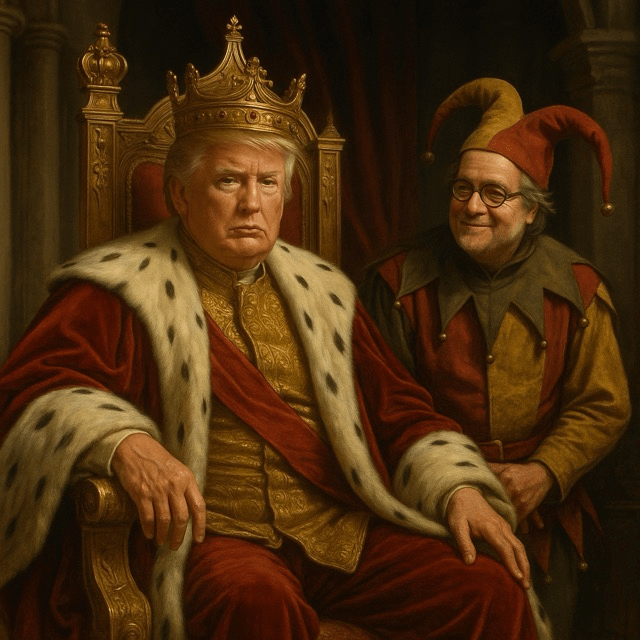
As the United States exits international bodies one by one, President Trump ascends the throne with Steve Bannon as his jester
In a dramatic escalation of America’s departure from the global stage, President Donald Trump announced on June 14, 2025, that the United States will withdraw from the Group of Seven (G7) summit, further distancing itself from key international alliances. This decision marks yet another step in Trump’s broader strategy of unilateralism, following earlier exits from the World Health Organization, the Paris Agreement, and other bodies. Observers warn that this pattern risks isolating the country diplomatically and undermining decades of post-war consensus built on multilateral cooperation.
The G7, comprising the world’s major democratic economies, has long served as a forum for addressing global crises ranging from economic recessions to climate challenges. Trump’s withdrawal statement, delivered via a terse White House press release, framed the move as a stand against “elitist global cabals” that supposedly disadvantage American workers. Critics argue that abandoning the G7 sacrifices U.S. influence, cedes leadership to rivals like China, and emboldens authoritarian regimes that thrive in the absence of unified democratic pressure.
This latest pullback follows a sequence of departures from international institutions. In May 2020, the United States left the World Health Organization amid tensions over pandemic responses. The UNESCO exit in late 2021 and the August 2022 departure from the International Criminal Court signaled a broader retreat from rules-based frameworks. Even the World Trade Organization has been hamstrung by U.S. blocking of judicial appointments. Taken together, these withdrawals reveal a coherent ideology: America First translated into America Alone.
The implications for global order are profound. Without U.S. leadership in key forums, initiatives to combat climate change, regulate digital economies, and address security threats may lose momentum or collapse altogether. Allies in Europe and Asia have expressed bewilderment, warning that unilateral action erodes trust. A fracturing of alliances could invite adversaries to fill the void, reshaping geopolitical dynamics in unpredictable ways and diminishing Washington’s capacity to marshal unified responses to crises.
Donald Trump’s modus operandi in these withdrawals echoes monarchical proclamations more than presidential policy. His rhetoric frames himself as the solitary sovereign defending the realm against external conspiracies. Each exit decree resembles an edict from a throne room—sudden, absolute, and devoid of collaborative negotiation. This approach has reignited debates over the balance of power in the American political system and the erosion of checks and balances in foreign policy decision-making.
At his side stands Steve Bannon, the former chief strategist, who now portrays himself as the court jester in this new imperial court. Bannon’s role involves amplifying Trump’s combative narratives, whipping up populist fervor, and deflecting criticism with barbed commentary. In medieval courts, jesters entertained kings while often speaking truths that courtiers dared not voice; today, Bannon uses his platform to rally supporters around Trump’s isolationist vision, even as traditional diplomatic channels crumble.
Domestic reactions have been split along partisan lines. Supporters laud the G7 withdrawal as a bold move that prioritizes American sovereignty and cuts the U.S. free from “burdensome” international commitments. Opponents decry it as reckless and short-sighted, risking economic turmoil and global instability. Internationally, allied leaders have issued statements of regret and confusion, with some suggesting the United States is no longer a reliable partner on issues ranging from trade to security.
As the world watches, the United States stands at a crossroads. Will future administrations seek to rejoin multilateral institutions and rebuild alliances, or has America’s longstanding role as a leader among democracies been irreversibly altered? For now, Trump’s reign—and Bannon’s jester show—continue to dominate headlines, leaving diplomats and citizens alike to ponder the fate of global cooperation in this era of unilateral rule.

 The Tower Post