Clandestine facilities, warhead blueprints, and high‑level enrichment suggest a covert military dimension to Iran’s atomic ambitions
Introduction
Tehran has long insisted that its nuclear program is devoted solely to peaceful energy and medical research. Yet over two decades of inspections, intelligence leaks, and scientific sampling have painted a more ambiguous picture—one that points to systematic work on a bomb design dormant but never entirely abandoned. This article distils the major strands of evidence: secret sites exposed by satellite, weaponization files spirited out of Tehran, and enrichment data showing how quickly Iran could now sprint to weapons‑grade material.
1. The First Red Flags: Natanz and Arak (2002–2004)
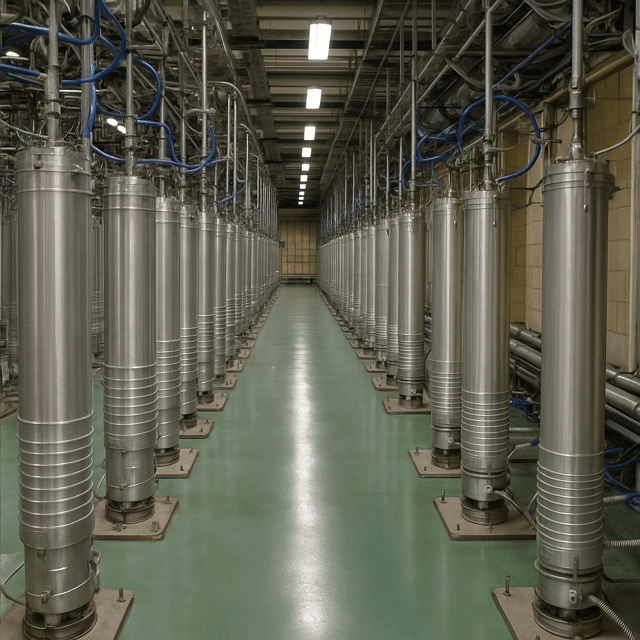
Iran’s clandestine construction of the Natanz enrichment plant and the heavy‑water reactor at Arak came to light only after dissident revelations in August 2002. Both facilities are dual‑use by nature: centrifuges at Natanz can enrich uranium beyond reactor levels, while a heavy‑water reactor yields plutonium suitable for a warhead’s core. Their existence—concealed from the International Atomic Energy Agency (IAEA) in violation of Iran’s safeguards agreement—was the first sign that nuclear activities were proceeding outside declared channels.
2. IAEA’s “Possible Military Dimensions” Dossier
Throughout the 2000s the IAEA compiled documentation on studies it feared were “related to the development of a nuclear explosive device.” The Agency’s November 2011 assessment listed high‑explosive hydrodynamic testing, neutron initiator experiments, and computer modelling of a 10‑kiloton warhead fitting atop Iran’s Shahab‑3 missile. Tehran dismissed the file as forged, but the IAEA deemed much of the data “credible”—particularly videos of hemispherical high‑explosive lenses being detonated at a military base south‑east of Tehran.
3. The Parchin Explosive Chamber
One site in that 2011 dossier, the Parchin military complex, became a litmus test. Inspectors sought access to a large steel chamber where Iran was suspected of simulating the compression of a uranium core. Satellite imagery from 2012–13 showed Iran razing buildings, asphalting roads, and even scraping off topsoil just before inspectors arrived. Although microscopic uranium particles were later detected in swipe samples, the clean‑up denied the IAEA the smoking gun of intact equipment.
4. The Nuclear Archive Seized in 2018
In January 2018 Israeli agents extracted some 55,000 pages and 183 CD‑ROMs from a Tehran warehouse. The cache chronicled Project Amad, a turnkey weaponization effort halted in 2003 but migrated into covert “SPND” institutes. Among the files were schematics for neutron initiators, Farsi‑language spreadsheets tracking “warhead detonation tests,” and step‑by‑step instructions for casting uranium metal hemispheres. Independent analysts who reviewed the archive concluded it corroborated, and in places amplified, the IAEA’s earlier concerns.
5. Advanced Enrichment: From 20% to 83.7%
Under the 2015 Joint Comprehensive Plan of Action (JCPOA) Iran capped enrichment at 3.67 percent. After the United States withdrew in 2018, Tehran escalated: 20 percent (January 2021), 60 percent (April 2021), and by February 2023 the IAEA detected particles enriched to 83.7 percent—just shy of the 90 percent weapons threshold—at the Fordow underground plant. While Iran called the finding a “transient fluctuation,” the capability demonstrates precise cascade tuning akin to a pilot weapon‑grade run.
6. Uranium‑Metal Production
In February 2021 Iran informed the Agency it would produce uranium metal ostensibly for reactor fuel plates. Weapon designers, however, also require metal to form bomb cores. Europe’s E3 negotiators argued that no civilian reactor in Iran needed such plates; the move thus signalled at least an R&D interest in weapon components.
7. Stockpiles and Breakout Calculus 2025
The IAEA’s May 2025 verification report estimates Iran possesses over 140 kg of 60 percent enriched uranium—convertible into seven weapon‑sized quantities of 25 kg each in roughly three weeks if cascades are reconfigured for 90 percent output. Deploying advanced IR‑6 centrifuges at both Natanz and Fordow compresses that timeline further, leaving weaponization—fashioning a device and mating it to a delivery system—as the longer pole.
8. Ballistic Delivery Work: Project 111
Documents from both the 2011 IAEA file and the 2018 archive reference Project 111, devoted to fitting a compact nuclear package into the nose cone of Iran’s Shahab family of missiles. Computer models depict stress‑tests of a re‑entry vehicle shielding a payload against re‑entry heat at 1500 °C, a parameter irrelevant to civilian space launchers but critical for warheads.
9. Obstacles to Full Proof
Skeptics rightly note that no intelligence service has produced photographs of an assembled Iranian bomb, nor has the IAEA confirmed actual diversion of nuclear material. Weaponization work after 2003 appears compartmentalized and easily deniable. Tehran’s decision calculus—whether to remain a “threshold” state or cross it—remains opaque.
10. Conclusion
Taken individually, each strand of evidence—hidden facilities, specialized explosions, enriched particles—invites alternative explanations. Together they trace a coherent trajectory: from clandestine enrichment, through weapon‑specific research, to an infrastructure now poised to deliver weapons‑grade fissile material in days. Iran may not have decided to build a bomb, but it has created the option, preserving design know‑how, and shielding sensitive experiments behind military barricades. That option, more than any declaration, constitutes the strongest proof that its nuclear quest has never been purely peaceful.

 The Tower Post