Examining the period when Western nations cooperated with Iran’s nuclear ambitions
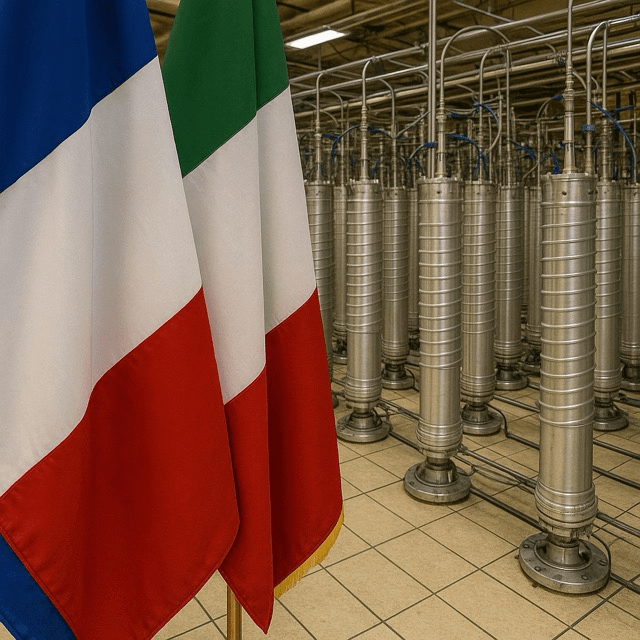
In the modern discourse surrounding Iran’s nuclear program, much of the attention focuses on recent developments, sanctions, and international negotiations. However, fewer people recall a surprising chapter in history: the period when Iran was actively supported in its nuclear endeavors by Western allies—most notably France and Italy. In the 1970s, during the reign of Shah Mohammad Reza Pahlavi, Iran was not only seen as a key geopolitical ally in the Middle East but also a promising candidate for nuclear cooperation.
### France: Uranium and Eurodif
One of the most important chapters in Iran’s early nuclear history involves France. In 1974, Iran signed an agreement to invest in the French uranium enrichment consortium known as Eurodif (European Gaseous Diffusion Uranium Enrichment Consortium). Under the terms of the deal, Iran was to invest more than $1 billion in exchange for a guaranteed supply of enriched uranium for its future nuclear reactors.
Iran, through its national atomic agency, acquired a 10% stake in the Eurodif company. At the time, this was seen as a win-win arrangement—France would benefit from Iranian capital, and Iran would secure a long-term source of nuclear fuel. However, after the 1979 Islamic Revolution, France froze deliveries of enriched uranium to Iran, citing the radical shift in Tehran’s political direction and mounting concerns over nuclear proliferation.
Despite legal battles and diplomatic standoffs, Iran never received its share of the uranium. This fallout left a deep scar in Franco-Iranian relations, and the Eurodif affair is still cited by Iranian officials as a betrayal of international trust and contracts.
### Italy: The Centrifuge Technology Connection
While France played a key role in uranium supply, Italy contributed to Iran’s early centrifuge development. During the 1970s, Italy’s relationship with Iran was warm, fostered by economic and energy partnerships. Italy’s role came into focus through the company CNEN (Comitato Nazionale per l’Energia Nucleare), the precursor to Italy’s current ENEA.
CNEN was involved in cooperative nuclear research with Iran, including the sale of laboratory-scale gas centrifuge equipment and sharing of related documentation. While not military in nature, this technology had dual-use potential, making it highly valuable to any aspiring enrichment program.
Iranian scientists received training and exposure to European enrichment methods, enabling Iran to develop domestic expertise that would later become critical in its clandestine centrifuge efforts. Though Italy, like France, curtailed its nuclear cooperation after 1979, the foundational knowledge had already been transferred.
### Lessons from the Past
The collaboration between France, Italy, and Iran during the Shah’s era illustrates how geopolitical alliances and economic interests often override long-term proliferation concerns—at least temporarily. At the time, Iran was seen as a stable, secular partner and a bulwark against Soviet influence. Its nuclear ambitions were framed in terms of peaceful energy production, with Western countries eager to engage.
The Eurodif investment and Italian technology transfer had lasting consequences. Though disrupted by the Revolution and Western policy shifts, these early contributions helped lay the groundwork for Iran’s independent nuclear infrastructure.
### Conclusion
Today’s fears about Iran’s nuclear intentions cannot be separated from this overlooked history. The very countries now seeking to constrain Iran’s nuclear capabilities were, for a time, key enablers of its nuclear infancy. The past reveals a complex web of cooperation, broken promises, and shifting alliances—reminding us that nuclear proliferation is often rooted in decisions made long before the present headlines.
 The Tower Post