A Strategic Pivot in Middle Eastern Air Dynamics as Israeli Forces Assert Aerial Dominance Over Iran
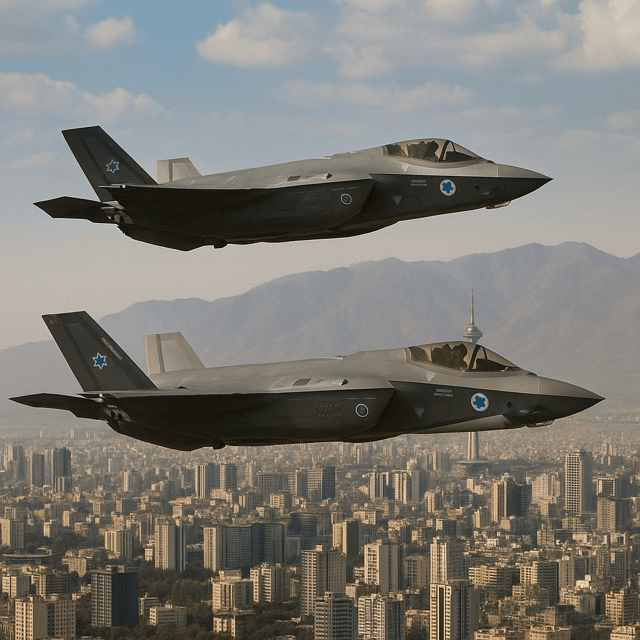
In a move that has sent shockwaves through the geopolitical landscape, the Israeli Air Force (IAF) announced on June 17, 2025, that it has established air control operations over Tehran’s airspace. This announcement, delivered by IAF spokesperson Colonel Avi Cohen, marks an unprecedented extension of Israeli military reach into the heart of Iran. According to official statements, a combination of advanced drones, electronic warfare systems, and stealth fighters now maintain continuous surveillance and, if necessary, kinetic capabilities above Tehran and its surrounding provinces.
The operation, codenamed “Desert Falcon,” reportedly began covertly in late May, leveraging satellite guidance and long-range unmanned aerial vehicles (UAVs) to penetrate Iranian radar coverage. The IAF claims its drones, including the Heron TP and Eitan platforms, operate from bases in the Negev Desert, transmitting real-time intelligence to command centers in Tel Aviv. Meanwhile, a squadron of F-35I Adir stealth jets provides a protective umbrella, ready to engage any Iranian air defense threats that might attempt to intercept.
Israel’s strategic rationale for “Desert Falcon” stems from escalating tensions following a series of clandestine operations attributed to Tehran—ranging from cyberattacks on Israeli infrastructure to strikes against Israeli-aligned militias in Syria. Israeli defense analysts assert that controlling the skies over Tehran serves as both a deterrent and an intelligence goldmine, allowing Israel to monitor leadership movements, military installations, and missile development sites with unparalleled precision.
Iranian state media swiftly condemned the revelation as “fabricated propaganda” and a blatant violation of Iranian sovereignty. The Islamic Republic’s Air Defense Force convened an emergency session, vowing to deploy advanced S-400 and Bavar-373 surface-to-air missile (SAM) batteries to counter any incursions. Nonetheless, military experts cast doubt on Iran’s capacity to neutralize stealth assets deep within its own borders, citing persistent maintenance issues and limited operational readiness within the IRGC’s air defense units.
International reactions have been mixed. The United States expressed cautious support, with the Pentagon’s press office noting that “Israel’s operations align with shared security interests” in curbing Tehran’s destabilizing activities. Conversely, Russia and China issued joint statements condemning unilateral actions that undermine international norms. The United Nations Security Council scheduled an emergency meeting to address the escalating aerial standoff, with diplomats warning of the risk of miscalculation that could ignite a broader conflict.
Analysts emphasize the technical prowess required for sustained air control over a capital city fortified by layered defenses. Israeli electronic warfare specialists have reportedly jammed Iranian radars, while cyber operators injected false signals into air defense networks, creating corridors for UAV ingress. Meanwhile, airborne refueling tankers extended the range of Adir fighters, allowing them to patrol Tehran’s airspace around the clock. These capabilities reflect years of IAF modernization and deep lessons learned during conflicts in Lebanon, Gaza, and Syria.
Domestically, the Israeli government framed “Desert Falcon” as a necessary preemptive measure to safeguard national security. Prime Minister Naomi Ben-David praised the IAF’s precision, asserting that “control of the skies is control of our future.” Opposition voices, however, cautioned that the operation risks dragging Israel into a wider war, decrying a lack of parliamentary oversight and transparency.
Within Tehran, citizens reported spotting high-altitude drones and hearing unverified sonic booms, fueling rumors of imminent strike packages. Dissident Iranian journalists seized upon the IAF’s declaration to criticize the regime’s failure to protect its own airspace. Yet, the Islamic Republic’s leadership maintained a façade of calm, highlighting recent military parades and missile tests as evidence of readiness.
As “Desert Falcon” continues, the broader Middle Eastern strategic equilibrium faces a critical test. Israel’s assertion of air dominance over Tehran challenges traditional notions of sanctuary and raises profound questions about sovereignty and deterrence. Whether this operation will herald a new era of remote conflict management or provoke a dangerous escalation remains to be seen—and the world watches with bated breath at the unfolding aerial chess match above the Iranian capital.


 The Tower Post