A sudden barrage pierces Israel’s defenses, shaking the city’s core and stoking fears of a wider regional war.
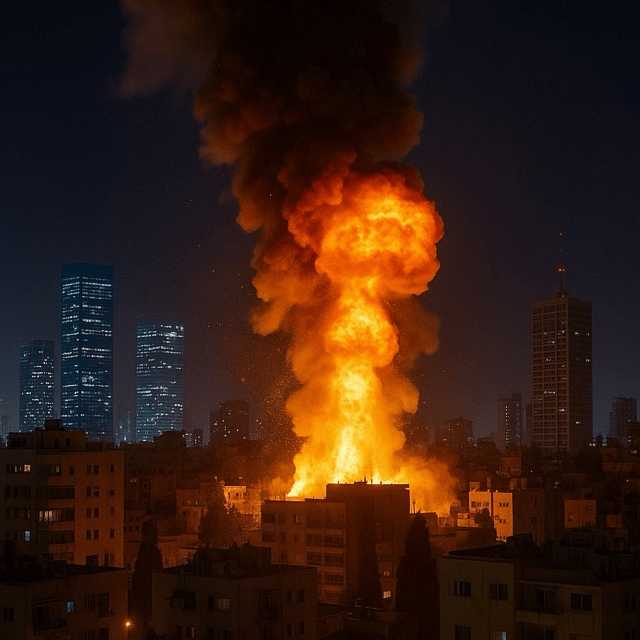
In the pre-dawn hours of June 19, a sudden volley of missiles launched from Iranian soil tore through the sky, descending upon central Tel Aviv with a terrifying precision. Within minutes, the city’s iconic skyline was punctuated by smoke plumes rising from shattered buildings, as air raid sirens wailed and civilians scrambled for cover. Witnesses described scenes of chaos, with cars abandoned in the streets and families huddled in stairwells, uncertain where the next strike might land.
According to Israeli defense officials, several medium-range ballistic missiles breached the Iron Dome perimeter, striking key commercial and residential districts in the city center. Among the hardest hit were the bustling Rothschild Boulevard and the adjacent Dizengoff Square, areas normally alive with morning commuters and café patrons. Emergency services rushed to the scene, battling fires in high-rise structures and rescuing those trapped under debris.
Preliminary reports indicate at least 48 civilians were killed and over 300 injured, with casualties ranging from minor shrapnel wounds to severe trauma. Hospitals in Tel Aviv and neighboring Holon announced emergency protocols, diverting incoming patients to trauma centers across the region. Medical teams worked through the morning to tend to the wounded, setting up makeshift triage tents outside fully occupied emergency rooms.
Israel’s Prime Minister, addressing the nation from the Knesset compound, condemned the strike as a “blatant act of aggression” and vowed an immediate and decisive response. “We will not tolerate attacks on our sovereign territory,” he declared, praising the Iron Dome units for saving hundreds of lives and promising to hold the Iranian leadership accountable. Iran’s Revolutionary Guard, in a statement released on state television, claimed the operation was retaliation for recent Israeli air raids on Iranian nuclear facilities.
The international community reacted swiftly to the escalation. The United States State Department issued a stern warning against further aggression, affirming Israel’s right to self-defense and pledging to expedite shipment of additional air defense systems. The United Nations Security Council convened an emergency session, where member states voiced concerns about the growing spiral of violence. Meanwhile, European leaders called for restraint and offered to mediate urgent de-escalation talks in Geneva.
As dusk fell over the shattered streets of Tel Aviv, a palpable sense of unease lingered. Shops remained shuttered, and a curfew was imposed citywide as authorities cleared rubble and assessed structural damage. For many residents, the echoes of the morning’s devastation served as a stark reminder of the conflict’s unpredictable reach. With both sides digging in, the strike on Tel Aviv’s heart threatens to ignite a broader confrontation, one whose outcome may reshape the region for years to come.

 The Tower Post