France’s decision to sideline Israeli defense companies at the Paris Air Show sparks diplomatic backlash and fuels debate over European neutrality.
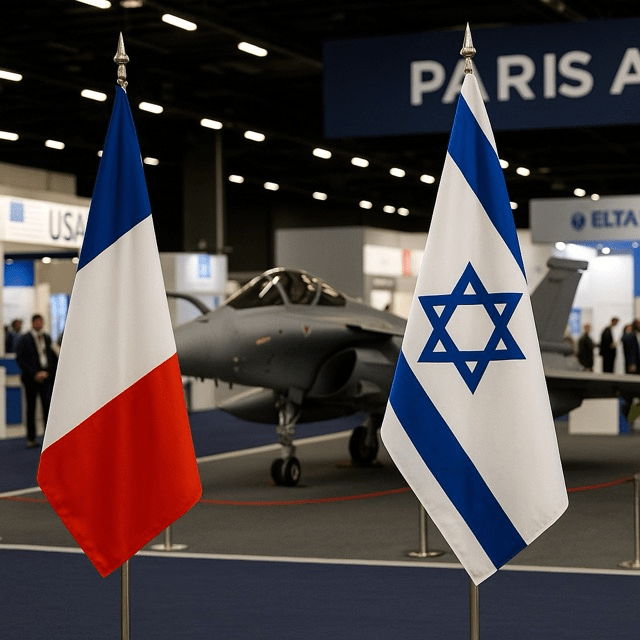
In a move that has shocked international observers and defense industry insiders alike, the French government has reportedly ordered the obscuring or exclusion of Israeli exhibitors at this year’s Paris Air Show. The decision—widely seen as a political gesture by President Emmanuel Macron’s administration—has ignited diplomatic tensions and raised questions about France’s stance in the ongoing Middle Eastern conflict.
Traditionally a stage for cutting-edge aerospace innovation and multinational collaboration, the Paris Air Show has long welcomed global defense players. This year, however, several Israeli companies, including major players in drone and missile defense technology, were reportedly denied prominent placement or asked to remove national identifiers. In some cases, entire booths were shrouded or relocated out of high-traffic areas, prompting outrage from both industry leaders and international observers.
The official reason given by French authorities is the need to “ensure public safety and diplomatic balance” amid growing protests and tensions linked to the Israel-Gaza conflict. Behind closed doors, however, sources suggest the move was heavily influenced by domestic political pressure and Macron’s desire to project a more ‘balanced’ or even sympathetic image to France’s sizable Muslim population and pro-Palestinian activist base.
Israel’s Ministry of Foreign Affairs condemned the decision as “discriminatory and deeply inappropriate,” stating that it undermines the principles of free trade and political neutrality that international exhibitions are meant to uphold. The Defense Ministry added that such exclusion weakens Europe’s own strategic position, particularly as Israeli defense technologies have become increasingly important to NATO interoperability and European border security.
Industry experts point out that this exclusion could backfire economically for France. Israeli defense firms are not only prolific innovators—particularly in AI-enabled targeting, surveillance, and missile shielding—but they also represent lucrative commercial partnerships. Analysts warn that sidelining these firms could drive them toward more receptive markets in Asia and Eastern Europe, where military procurement is rapidly accelerating.
Macron’s critics within France have seized the opportunity to highlight what they see as a pattern of performative diplomacy—actions meant to garner domestic favor at the expense of international credibility. “You don’t promote peace by selectively silencing one side,” remarked a French parliamentary official speaking on condition of anonymity. “If the Air Show can’t remain a neutral platform for innovation and dialogue, we risk turning it into a political theater.”
Beyond the air show, the incident has reignited debate over Europe’s broader diplomatic posture. As global polarization intensifies—with new alliances forming across the Middle East, Asia, and the Global South—France’s attempt to redefine its influence in a post-American world may be sowing more confusion than clarity.
The long-term consequences of this decision remain uncertain. Israeli defense firms may reevaluate their participation in future European expos, while other countries may perceive the exclusion as precedent-setting. More broadly, Macron’s move could weaken France’s influence as a diplomatic mediator in Middle Eastern affairs—precisely the role Paris has historically sought to uphold.
In the wake of this controversial episode, what remains clear is that the intersection of commerce, politics, and defense has become more fraught than ever. The Paris Air Show, once a symbol of cooperative advancement, now finds itself at the center of a geopolitical rift that shows no signs of resolution.

 The Tower Post