Rocket System Development Delayed as Federal Aviation Administration Advisory is Put on Hold

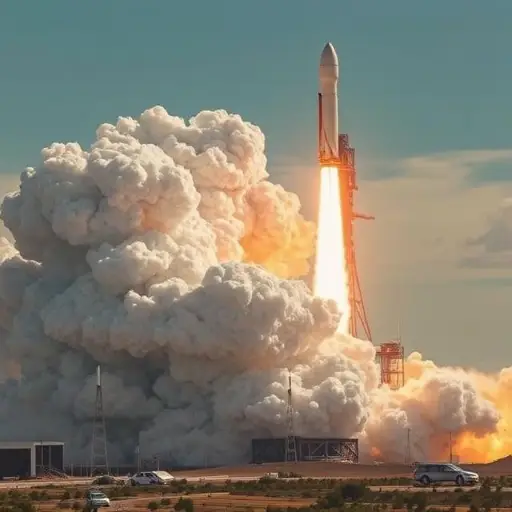
A catastrophic explosion occurred on a test stand in Texas late Wednesday night, as SpaceX prepared for the tenth test flight of its heavy-lift Starship rocket system. According to the company, all personnel are safe and accounted for, with no hazards reported to residents in surrounding communities. However, the enormous blast caused significant damage to the area surrounding the test stand.
In an initial analysis, SpaceX revealed that the explosion was likely caused by a failure of a pressurized tank known as a COPV, or composite overwrapped pressure vessel, in the Starship’s nosecone. The company was preparing to perform a “static fire” of the Starship’s six Raptor engines at the time of the explosion, and the area had been cleared prior to the blast.
The Starship, which stands at 171 feet tall, is a reusable spacecraft designed to take both people and cargo to the Moon, Mars, and other destinations in the solar system. The rocket system is being developed by SpaceX with the aim of establishing a permanent, self-sustaining human presence on Mars. The Starship is expected to be capable of carrying up to 100 passengers and will be powered by six Raptor engines, which are capable of producing 200 tons of thrust.
The explosion is the latest setback for the Starship program, which has faced numerous challenges and delays since its inception. In January, the rocket unexpectedly exploded during its seventh test flight, and it failed again in March and May. Despite making it further into its most recent flight in May than during the previous two tests, the rocket still failed to deploy the dummy Starlink satellites it was carrying onboard – a crucial step in the company’s plan to use the mega-rocket to grow its space-based internet service.
Musk has maintained that SpaceX is on track to try to send a Starship to Mars in 2026, giving it a “50/50” chance. The company is also developing a larger “Version 3” of Starship that could fly as early as this year. The new version is expected to be capable of carrying even more cargo and passengers, and will feature a number of improvements over the current design.
The explosion is also likely to impact the company’s plans for its Starship development site in Boca Chica, Texas, where the test stand is located. The site, which has been the focus of intense development activity in recent months, is expected to play a key role in the company’s plans to launch the Starship on a number of test flights in the coming months.
As SpaceX works to determine the cause of the explosion and implement necessary changes, the development of the Starship rocket system is likely to face further delays. However, the company remains committed to its ambitious plans for the Starship, and is expected to continue working towards its goal of establishing a permanent human presence on Mars.