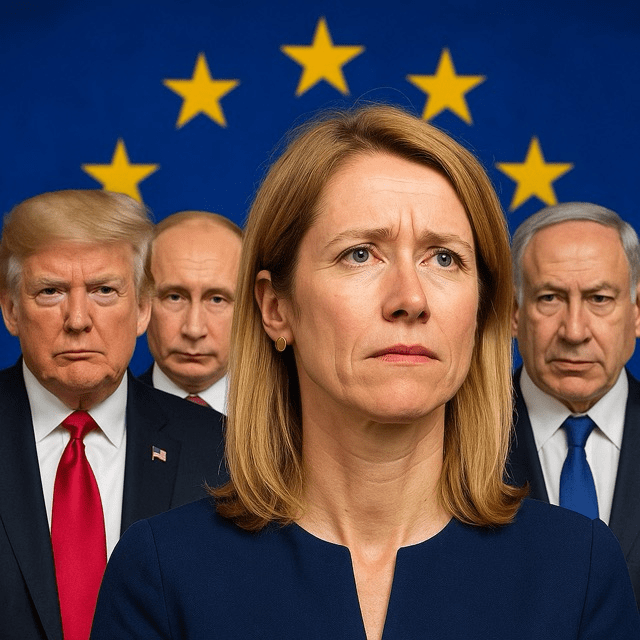
If Kaja Kallas, former Prime Minister of Estonia, were empowered to act as the single voice of the European Union in international diplomacy—particularly in high-stakes dialogues with figures like Donald Trump, Vladimir Putin, and Benjamin Netanyahu—the EU could gain in clarity, credibility, and strategic cohesion.
1. Coherence and Credibility in Defending Democratic Values
Kallas is known for her uncompromising defense of democracy, rule of law, and European unity. She would present a clear and consistent message, especially in contrast to the ambiguous or divided stances often seen from Brussels. Facing Trump’s populist maneuvers or Putin’s authoritarian tactics, Kallas would embody European principles with confidence and authority.
2. Stronger Pressure on Putin
Given her experience as a Baltic leader, Kallas has firsthand understanding of the Russian threat. She has shown resilience and decisiveness in defending Ukraine and countering Moscow’s influence. A unified EU voice through Kallas would signal resolve and eliminate mixed messages, enhancing deterrence and unity on sanctions and military support.
3. A More Courageous and Balanced Approach to Netanyahu
The EU has long struggled to maintain credibility in the Israeli-Palestinian conflict. Kallas could strike a more principled balance—supporting Israel’s right to security while clearly condemning excessive use of force or violations of international law. Her leadership could revitalize EU diplomacy and increase its relevance in the region.
4. Visible and Consistent Strategic Deterrence
Kallas understands deterrence not just as military strength, but as strategic coherence. She could coordinate EU foreign and defense policy with greater effectiveness, giving the Union a stronger geopolitical identity and reducing its current ambiguity.
5. Greater Inclusion and Legitimacy for Eastern Europe
Kallas’s leadership would symbolize the recognition of Eastern European perspectives within EU policy. This shift could foster a stronger internal unity, enhance trust among newer member states, and send a powerful message that all EU voices count equally.
Conclusion: Strategic and Symbolic Impact
Allowing Kallas to speak as the unified foreign voice of Europe would elevate the EU’s strategic coherence, moral authority, and internal solidarity. Her clarity, conviction, and courage could transform how the Union is perceived—not only by global powers but by its own citizens. In a multipolar world, Kallas wouldn’t just represent Europe—she would embody its best potential.


 The Tower Post