From Revolutionary Legacy to Global Command: Inside the Unprecedented Authority of China’s Most Powerful Leader Since Mao
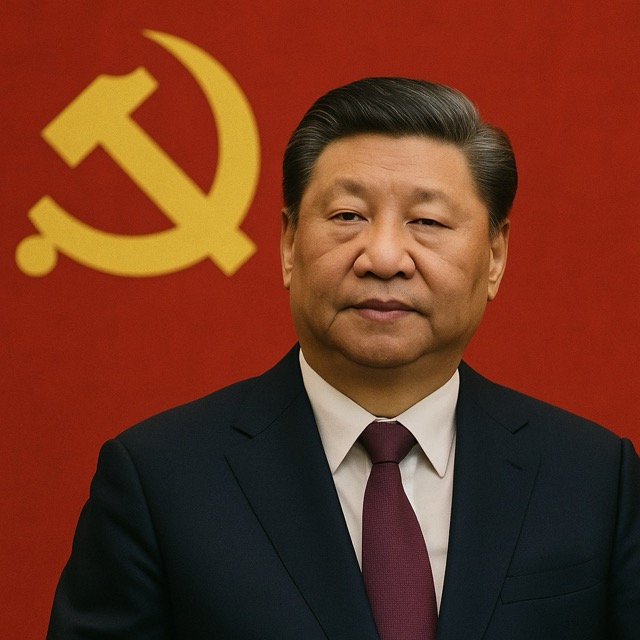
BEIJING — Xi Jinping, the unchallenged leader of the People’s Republic of China, has emerged not only as a commanding force within his nation but also as a pivotal figure reshaping the global order. Dubbed by some as the “Emperor of the Hammer and Sickle,” Xi has accumulated power at a level unseen in China since Mao Zedong, blending the legacy of communist rule with a modern authoritarian blueprint.
Xi’s roots lie deep in revolutionary soil. Born in 1953, he is the son of Xi Zhongxun, a veteran revolutionary and former vice premier. But the privileges of “red aristocracy” were not always protective. During the Cultural Revolution, his father fell out of favor, and a young Xi was sent to the countryside for “reeducation.” The experience, harsh and humbling, forged the resilience that would define his later leadership.
Returning to political life, Xi climbed the ranks through provincial governance, holding leadership positions in Fujian, Zhejiang, and Shanghai. Known for his low-profile style and bureaucratic discipline, he was chosen as a compromise candidate during a time of inner-party tension — a choice that would soon upend China’s political landscape.
Since becoming General Secretary of the Communist Party in 2012, Xi has orchestrated a sweeping consolidation of power. He dismantled rival factions through a high-profile anti-corruption campaign, sidelined opponents, and eliminated term limits, allowing him to remain president indefinitely. “Xi Jinping Thought” was enshrined in the Party’s constitution, cementing his ideological dominance.
Observers note that Xi’s governance fuses nationalism with state-driven capitalism, ideological revivalism, and technological surveillance. His control extends across every pillar of Chinese society: from media to academia, from military to religion. Under his rule, the Communist Party has inserted itself into boardrooms and classrooms alike, ensuring loyalty to the regime’s narrative.
Xi’s assertive foreign policy reflects his domestic centralization. Through the Belt and Road Initiative, China has extended its economic influence across continents. In the South China Sea, Taiwan Strait, and beyond, Xi has adopted a stance of strategic defiance, prompting growing unease in Washington, Brussels, and neighboring capitals.
The suppression of dissent — from Hong Kong’s autonomy to the internment of Uyghurs in Xinjiang — has drawn global condemnation. Yet domestically, Xi remains popular among many Chinese citizens, who credit him with restoring national pride and global stature.
Critics warn that Xi’s unchecked power risks strategic overreach and internal rigidity. “In concentrating authority, Xi has stifled debate and institutional flexibility,” says Minxin Pei, a Chinese politics expert at Claremont McKenna College. “That may hinder long-term governance, especially in times of crisis.”
As Xi embarks on an unprecedented third term, he stands atop a political architecture built in his own image — disciplined, centralized, and increasingly opaque. Whether history will regard him as a stabilizer of Chinese destiny or an autocrat whose ambitions ignited global rivalries remains to be seen.
For now, one fact is undeniable: Xi Jinping holds the reins of a modern empire — vast, vigilant, and commanded from the heart of Beijing.

 The Tower Post