As Trump Sharpens His Rhetoric, Former Strategist Steve Bannon Offers a Glimpse into a Potentially Combative Future
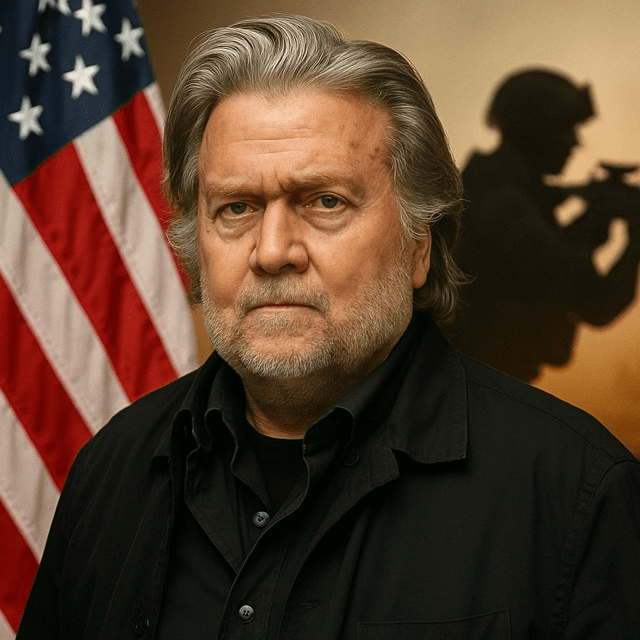
In a series of recent interviews and podcast appearances, Steve Bannon, former chief strategist to Donald Trump, has offered revealing insights into what he describes as the “new militaristic posture” of the former president. As Trump prepares for a potential return to the White House, Bannon’s comments have sparked renewed scrutiny over the former president’s foreign policy intentions—ones that appear increasingly assertive and confrontational.
“This isn’t 2016 Trump,” Bannon said during a broadcast of his War Room podcast. “This is a Trump who’s ready to project strength globally. He’s no longer about avoiding foreign entanglements—he’s about winning them.”
Bannon’s remarks suggest a sharp pivot from the isolationist rhetoric that characterized Trump’s first campaign. Instead, the new message centers on the need for rapid military readiness, assertive deterrence in Asia, and an aggressive posture toward Iran and radical Islamic terrorism. The shift has alarmed foreign policy analysts, many of whom are still grappling with the unpredictable legacy of Trump’s first term.
According to Bannon, Trump’s inner circle is crafting a framework that would “redefine American power in the 21st century.” He hinted at a doctrine built on rapid-force deployment, renegotiation of NATO’s rules of engagement, and a heightened role for the U.S. in cyber and space-based defense systems. “Trump understands that peace comes through strength—real, overwhelming strength,” Bannon added.
The commentary coincides with a broader evolution in Trump’s campaign messaging. On the trail, Trump has vowed to end “forever wars,” but also pledged to “crush” terrorist threats and “stand up to China and Russia in ways Biden never could.” This dual messaging—anti-war in tone but aggressive in posture—has led some critics to accuse Trump of incoherence or dangerous escalation.
“This is not strategic ambiguity—it’s strategic volatility,” said Dr. Elaine Ross, a professor of international security at Georgetown University. “Bannon is laying out a doctrine that sounds more like militarized nationalism than calculated deterrence.”
Bannon, for his part, dismissed concerns over global backlash. “America has been weak for too long,” he said. “Trump’s military policy will be unapologetic, targeted, and deeply rooted in national sovereignty.”
Behind the scenes, sources close to Trump have confirmed that his advisers are in talks with former military officials and defense contractors to map out a potential transition plan. “The idea is to be ready from Day One,” said one insider. “That means rebuilding the Pentagon’s operational priorities in line with Trump’s vision.”
Meanwhile, critics warn of the consequences. Allies in Europe and Asia have expressed unease about Trump’s return, fearing a breakdown in multilateral defense structures and a tilt toward unilateralism. Some in Washington also worry that such a doctrine could alienate moderate voters or spark internal rifts within the Republican Party.
Still, for Trump’s base—and for Bannon—it’s a message that resonates. “The world respects strength,” Bannon concluded. “And Trump is the only one willing to deliver it without apology.”
As the 2024 campaign intensifies, it’s becoming clear that foreign policy—and how America projects its military might—will be central to Trump’s platform. And with voices like Bannon amplifying that vision, the world is once again bracing for a presidency that could upend the global order.



 The Tower Post