Former President’s Surprise Agreement with Kremlin Casts Doubt on Collective Defense Commitment
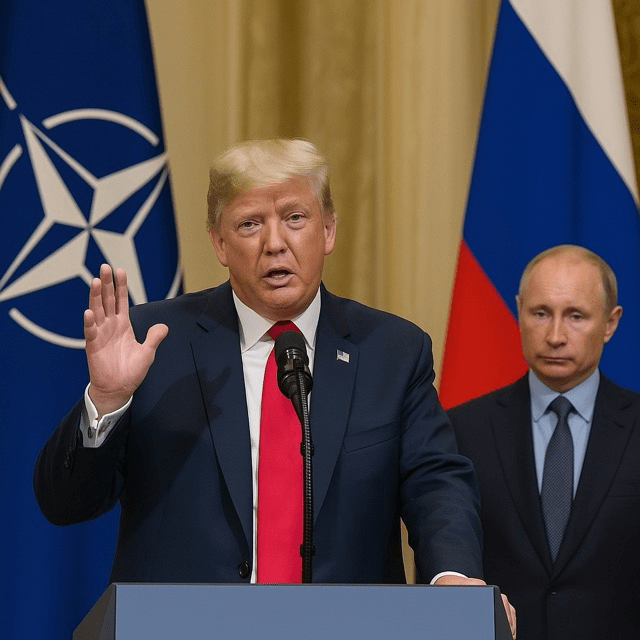
In a move that has sent shockwaves through Western capitals, former U.S. President Donald Trump has reportedly reached a surprise diplomatic understanding with the Russian Federation, raising significant concerns among NATO allies about the reliability of American commitment to Article 5—the cornerstone of the alliance’s collective defense mechanism.
According to multiple diplomatic sources, Trump, who is campaigning for a return to the White House in 2025, engaged in a series of unofficial discussions with high-level Russian officials. These talks are said to have culminated in a mutual understanding that would de-escalate military tensions in Eastern Europe, in exchange for a U.S. retraction of support for automatic military engagement under Article 5 in certain scenarios.
While the details of the agreement remain classified, insiders claim the arrangement includes a tacit agreement not to escalate U.S. military presence in countries like Poland and the Baltic states should minor border incursions or cyberattacks occur. The Kremlin has long viewed NATO’s expansion as a threat, and this deal appears to reflect a shift toward accommodating those security concerns—at the potential cost of NATO unity.
Reactions across Europe have been swift and intense. Germany’s Chancellor voiced “serious concern” over what she described as “a betrayal of the principles that have kept Europe secure since World War II.” French President Emmanuel Macron held an emergency meeting with defense ministers, warning that “Europe must prepare for strategic autonomy.”
In Washington, the White House has distanced itself from Trump’s actions, emphasizing that no private citizen has the authority to negotiate foreign policy. Nevertheless, the former president’s influence remains potent. Several Republican lawmakers have voiced support for a “redefinition” of NATO obligations, arguing that American interests have been too heavily burdened.
Article 5, which stipulates that an attack on one member state is considered an attack on all, has only been invoked once in NATO’s history—after the September 11 attacks. For decades, it has served as the ultimate deterrent against aggression. Trump’s apparent willingness to renegotiate its implications has been seen by critics as undermining that foundational promise.
In Eastern Europe, fears are particularly acute. Lithuania’s Foreign Minister expressed dismay: “We rely on NATO not just for security, but for survival. Any dilution of Article 5 sends the wrong message to authoritarian regimes.”
Analysts suggest this development could embolden Russia, which has increased military drills near NATO borders in recent months. Some experts even warn of a “geopolitical rebalancing” that might see smaller nations turning to alternative defense pacts.
With the U.S. presidential election approaching, Trump’s foreign policy overtures could play a critical role in shaping voter sentiment. His supporters hail the deal as a “step toward peace” and “a much-needed rethinking of endless entanglements.” Opponents see it as reckless appeasement.
As uncertainty looms, one thing is clear: Trump’s shadow diplomacy with Moscow has reignited a transatlantic debate over trust, defense, and the future of the West’s most important military alliance.




 The Tower Post