Controversial Proposal Would Reallocate West Bank and Gaza Territory to Israel, Relocate Palestinians to Refugee Zones
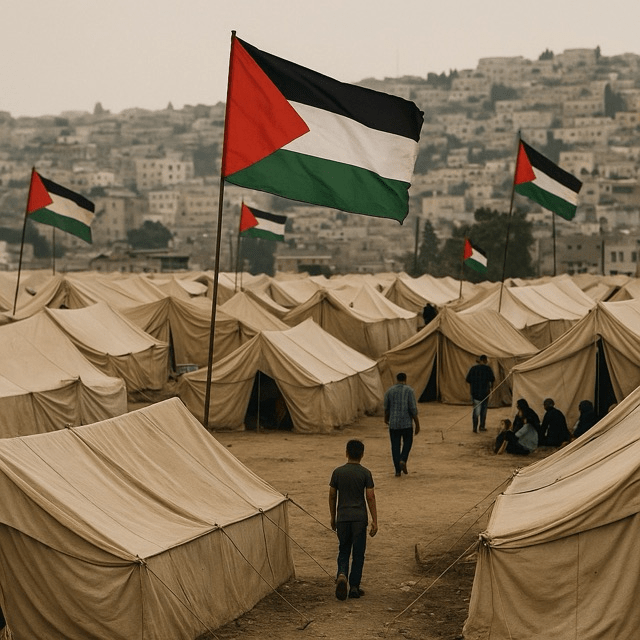
In a revelation that could reshape one of the world’s most entrenched conflicts, a confidential U.S. diplomatic blueprint to resolve the Israeli-Palestinian issue has reportedly surfaced through diplomatic sources. The proposed plan, not yet publicly acknowledged by the White House or the State Department, suggests a dramatic redrawing of borders and a controversial reconfiguration of Palestinian demographics.
According to the leak, the plan proposes transferring significant portions of the West Bank and Gaza Strip to full Israeli control, while relocating large numbers of Palestinians to newly created refugee zones under international supervision. The concept, reportedly developed over the past year by a closed team of U.S. and Israeli advisors, has already been met with fierce criticism from human rights groups and Palestinian leaders.
Under the plan, Israel would annex critical strategic corridors in the West Bank, including settlements deemed essential to Israeli security and economic infrastructure. Gaza, currently governed by Hamas, would be demilitarized, with coastal access and airspace fully controlled by Israel. In exchange, a series of temporary refugee zones—some within Jordanian and Egyptian borders—would house displaced Palestinians with the promise of international aid and reconstruction funds.
“This is not a peace plan. It’s a forced transfer dressed up as diplomacy,” said Hanan Ashrawi, a senior Palestinian politician and longtime negotiator. “Any solution that sidelines Palestinian sovereignty is not a solution—it’s a provocation.”
Sources close to the drafting process claim the U.S. is presenting the proposal as a “last resort” option in response to growing international fatigue over decades of failed negotiations. The Biden administration has remained publicly committed to a two-state solution, but rising regional instability and mounting Israeli pressure for territorial guarantees have reportedly accelerated alternative strategies.
Israeli Prime Minister Benjamin Netanyahu, while not confirming the specifics, recently hinted at a “historic opportunity” for normalization and regional security. “We will ensure that Israel’s future is secure and that our people are never again threatened at our borders,” he told the Knesset last week.
Reactions in Arab capitals have been swift and sharp. Jordan, which hosts millions of Palestinian refugees, rejected any plan that “outsources the crisis.” Egypt expressed concern over regional destabilization, and Qatar called the idea “unacceptable and inflammatory.”
Meanwhile, Washington has refused to confirm or deny the existence of the plan. In a press briefing, a State Department spokesperson said only: “We continue to explore every avenue for peace in the region.”
The proposed refugee zones, described as semi-autonomous camps governed by UN-administered civil bodies, would include schools, hospitals, and infrastructure funded by a consortium of Western and Gulf states. However, critics argue that such zones risk becoming permanent ghettos.
“It’s an old formula: separate and contain,” said Amnesty International’s Middle East Director. “The right of return, enshrined in international law, cannot be ignored for the sake of expediency.”
If the plan moves forward, it is likely to trigger both legal and political battles at the international level. The UN General Assembly has repeatedly upheld Palestinian self-determination, and the International Criminal Court is already reviewing alleged war crimes in the occupied territories.
For now, the plan remains unconfirmed and politically radioactive. Yet its very existence underscores a shifting calculus in Washington—one increasingly defined by pragmatism, regional alliances, and strategic deterrence over traditional diplomacy.
Whether the secret plan becomes a historic breakthrough or a catastrophic failure remains to be seen. One thing is certain: the roadmap to peace in the Middle East is once again under intense and controversial revision.




 The Tower Post