How NATO Allies from Norway to Poland Are Preparing for Potential Russian Aggression
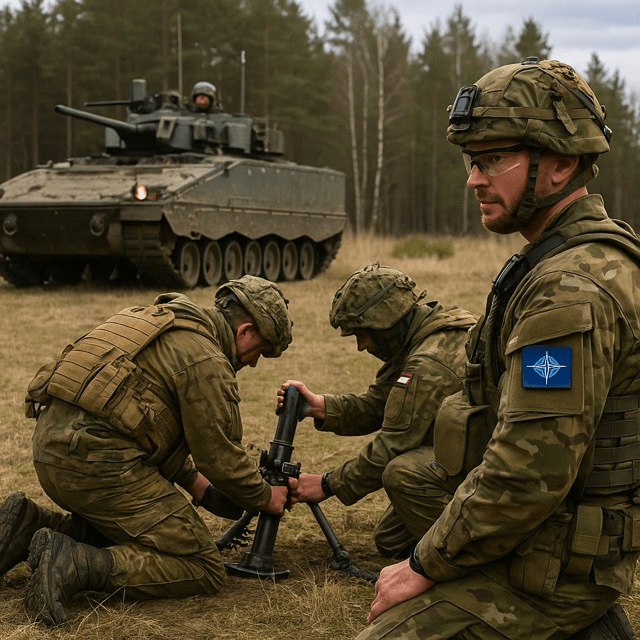
In the sparsely populated expanse of Norway’s Arctic region, NATO forces are conducting simulations to anticipate the contours of a potential Russian offensive. From icy mountain passes to the dense forests along Poland’s border with Belarus, the alliance is coordinating a host of military exercises designed to map out every conceivable avenue of attack.
The stakes are high. Since Russia’s annexation of Crimea in 2014 and its full-scale invasion of Ukraine in 2022, NATO has redrawn its strategic priorities. The eastern flank, once considered a quiet backwater, has become the frontline of deterrence against Moscow. This transformation has involved bolstering troop deployments, enhancing logistical networks, and integrating high-tech surveillance systems across multiple nations.
In January 2025, Norway hosted Exercise Arctic Sentinel, which brought together air and ground units from the United States, the United Kingdom, and several Nordic nations. Participants rehearsed defending vital infrastructure against simulated incursions, including the protection of airbases and reconnaissance outposts near the Barents Sea.
Simultaneously, Poland has expanded its own defensive posture. At the border with Belarus, where tensions simmer over Minsk’s support for Moscow’s ambitions, Warsaw has installed advanced radar installations and deployed additional mechanized brigades. These units are now routinely practicing rapid deployment drills, designed to respond within hours to any breach of sovereign territory.
Joint command centers have proven essential in knitting together these disparate efforts. A newly established NATO Coordination Hub in Gdansk ensures that intelligence gathered from Norwegian maritime patrols and Polish border sensors is instantly shared among allied commanders. The hub also oversees the placement of mobile anti-aircraft batteries, long-range artillery units, and the pre-positioning of critical supplies.
Technological innovation is also playing a crucial role. Allied nations are experimenting with artificial intelligence to analyze satellite imagery in real time, identifying troop movements and equipment buildups near the frontier. Unmanned aerial vehicles (UAVs) equipped with electro-optical sensors patrol the skies, relaying high-resolution footage back to command centers. This network-centric approach affords NATO a level of situational awareness previously unattainable in Europe’s northern latitudes.
Yet challenges remain. Harsh Arctic weather can ground drones and obscure satellite lenses, while dense forest cover along the Polish border complicates radar detection. Ground forces must be prepared to operate in temperatures well below freezing, and supply lines must be robust enough to function through snowstorms and icy roads.
To address these hurdles, NATO is investing in climate-hardened equipment and specialized training. Infantry units now train in winter warfare tactics, learning to navigate treacherous terrain and maintain operational readiness in subzero conditions. Engineers are developing insulated supply modules that can be transported by all-terrain vehicles, ensuring that ammunition and fuel reach frontline units without delay.
The overarching goal is clear: create a seamless defensive posture that spans thousands of kilometers. By integrating forces from Norway’s Arctic archipelago to Poland’s eastern border, NATO seeks to deny Russia any opportunity for a quick, tactical strike. The alliance’s ability to predict and counteract potential scenarios sends a powerful message of unity and resolve.
As the geopolitical landscape continues to shift, NATO’s eastern frontier stands as both a symbol and a bastion of collective defense. Through rigorous exercises, cutting-edge technology, and unwavering cooperation, allied nations are preparing for the unthinkable. In doing so, they underscore the enduring principle that Europe’s security is indivisible—and that an attack on one is an attack on all.




 The Tower Post