Persistent ceasefire violations and proxy clashes underscore a tense stalemate along the Line of Control
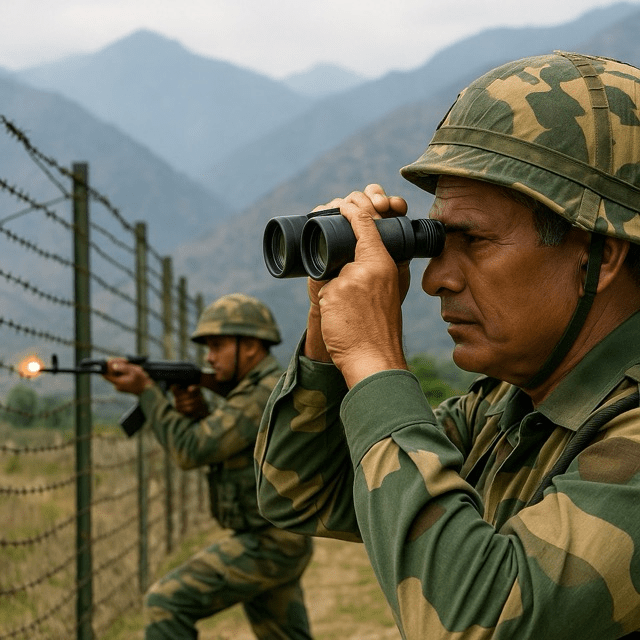
In recent months, India and Pakistan have been locked in a low-intensity conflict marked by frequent ceasefire violations along the Line of Control (LoC) in Kashmir. While neither side has escalated to full-scale warfare, sporadic exchanges of fire, drone overflights, and proxy engagements continue to keep both armies on high alert. The situation, which analysts describe as a “war by other means,” underscores the fragility of peace between two nuclear-armed neighbours.
This cycle of hostilities erupted in late April, following accusations by New Delhi that Pakistani-backed militants launched a deadly attack on a convoy in Pahalgam, killing 26 civilians. India responded with targeted air strikes and artillery fire against militant camps in Pakistan-administered Kashmir. Pakistan retaliated with its own barrage of rockets, prompting New Delhi to tighten security and suspend the Indus Waters Treaty as a punitive measure. Although a ceasefire was agreed on May 3, sporadic skirmishes have persisted.
According to the Stimson Center, the brief exchange of conventional strikes in May represented the most serious military crisis between the two nations in decades. Hundreds of drones and missile launches—some equipped with surveillance payloads—were intercepted or shot down, ushering in what commentators have labeled the “first drone war” between nuclear-armed rivals.
Despite international pressure led by the United States, which brokered the initial ceasefire, talks on substantive issues have stalled. Islamabad insists that water rights under the Indus Waters Treaty be fully restored before any meaningful dialogue, while New Delhi demands verifiable action against militant groups based in Pakistan. The suspension of the 1960 treaty, facilitated by the World Bank, has raised fears of a water crisis affecting millions downstream.
On the ground, soldiers endure harsh conditions. Patrols along rugged mountain ridges and forested valleys remain vulnerable to sniper fire and improvised explosive devices. Both armies have ramped up troop deployments, fortified bunkers, and increased aerial surveillance to monitor cross-border movements. Local villagers report that schools and clinics have closed temporarily, as communities brace for the next flare-up.
New Delhi has also tightened its rules of engagement, authorizing the Indian Army to respond with proportionate force to any Pakistani provocation. Islamabad’s military leadership, in turn, warns against “any further aggression,” hinting that it reserves the right to use “all necessary means,” a phrase widely interpreted as a reference to Pakistan’s nuclear capability. The rhetoric, though largely symbolic, exacerbates public anxiety on both sides of the border.
Economic and diplomatic measures have accompanied military posturing. India has curtailed bilateral trade and suspended key cross-border infrastructure projects, including the Kartarpur Corridor, previously seen as confidence-building. Pakistan, grappling with a fragile economy, has imposed reciprocal trade bans and announced new restrictions on Indian cultural imports. Both governments justify these steps as necessary safeguards against national security threats.
Despite the tensions, backchannel diplomacy continues. Third-party envoys—particularly from the United States and China—have pressed for renewed bilateral talks. Beijing, leveraging its ties with Islamabad, has offered to mediate, while Washington uses its influence in New Delhi to temper hardline stances. However, mutual distrust and domestic political pressures have so far prevented meaningful progress.
Analysts warn that prolonged low-intensity conflict can be as dangerous as open war. It normalizes violence, stretches military resources, and creates a volatile environment where miscalculations can trigger rapid escalation. The spectre of nuclear exchange hangs over even the most limited skirmish, making crisis management protocols and direct communication channels vital to avoid inadvertent catastrophe.
As both capitals prepare for possible monsoon-related challenges later in the year, the low-intensity war shows no signs of abating. For the communities along the LoC, day-to-day life oscillates between cautious hope for calm and the fear of renewed hostilities. In the wider region, stakeholders watch nervously, aware that this calculated stalemate could unravel with grave consequences.




 The Tower Post