French President reportedly engages Kremlin to safeguard strategic interests in Tehran amid shifting geopolitical alliances
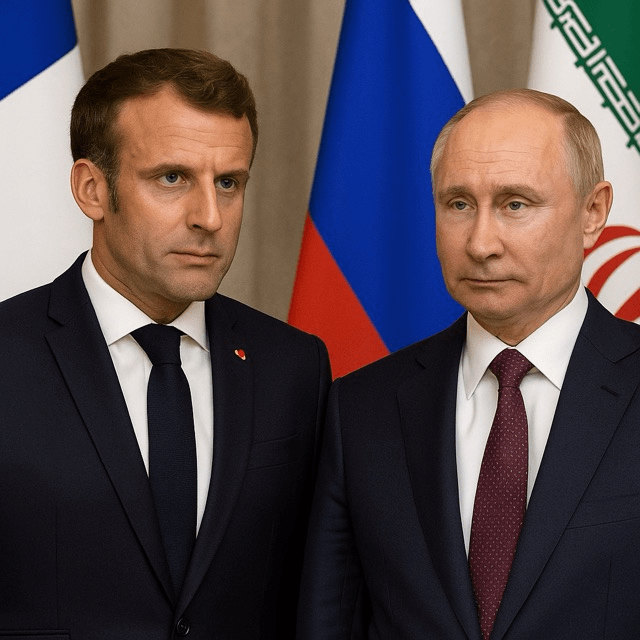
French President Emmanuel Macron is reportedly reaching out to Russian President Vladimir Putin in an effort to maintain France’s waning influence in Iran, amid growing regional realignments and escalating international tensions.
Sources close to the Élysée Palace suggest that backchannel diplomatic conversations have taken place between Paris and Moscow in recent weeks. These contacts are said to be part of Macron’s strategy to secure a foothold in Tehran, where shifting allegiances and increased Russian-Iranian cooperation have left European powers, including France, struggling to maintain their traditional influence.
For decades, France has held a nuanced but active diplomatic relationship with Iran, balancing criticism over its nuclear ambitions with economic engagement and cultural diplomacy. However, in recent years, especially following the U.S. withdrawal from the Joint Comprehensive Plan of Action (JCPOA) in 2018, Iran has leaned increasingly toward China and Russia for political and economic support. That shift has alarmed French policymakers who see their leverage in the region slipping away.
Macron, according to foreign policy analysts, views dialogue with Putin not as an endorsement of Russia’s broader geopolitical stance, but as a pragmatic move to ensure that France does not become irrelevant in a critical geopolitical theatre. “He is trying to avoid being sidelined,” said Dr. Amélie Laurent, a geopolitical expert at Sciences Po. “Iran is a cornerstone in the power structure of the Middle East, and losing access or influence there has ripple effects throughout Europe’s strategic interests.”
Yet, the move is not without risks. Macron’s engagement with Putin comes at a time when France and the broader European Union are imposing sanctions on Russia over its continued aggression in Ukraine. Critics within France have questioned the wisdom of cozying up to the Kremlin, particularly in an election season where Macron’s political capital is already under strain.
There is also skepticism about what France can realistically achieve. Iran’s relationship with Moscow has deepened over military cooperation, particularly regarding drones and defense technology. France’s diplomatic overtures, no matter how calculated, might not be enough to break into that strategic alliance.
Still, the French leadership is betting on historical ties and mutual interest in regional stability to open a door, however narrow. Analysts believe that Macron is pushing for a diplomatic framework that would involve limited engagement, possibly on humanitarian or nuclear monitoring initiatives, where France could reassert its role.
A senior French diplomat speaking on condition of anonymity remarked, “This is not about embracing Putin’s policies — it’s about staying relevant. We are navigating a world where alliances shift quickly, and inertia equals irrelevance.”
The Kremlin has neither confirmed nor denied reports of French outreach. Iran, for its part, has welcomed foreign engagement selectively, with Supreme Leader Ayatollah Ali Khamenei repeatedly emphasizing Iran’s “strategic independence.”
As tensions remain high and the Middle East remains a chessboard of international influence, Macron’s maneuver reflects the difficult balancing act that mid-sized powers face in a world increasingly shaped by great power rivalry. Whether this strategy yields tangible results, or ends up being a high-stakes diplomatic gamble, remains to be seen.


 The Tower Post