New bilateral framework echoes UK’s post-Brexit struggles over sovereignty, regulation, and migration
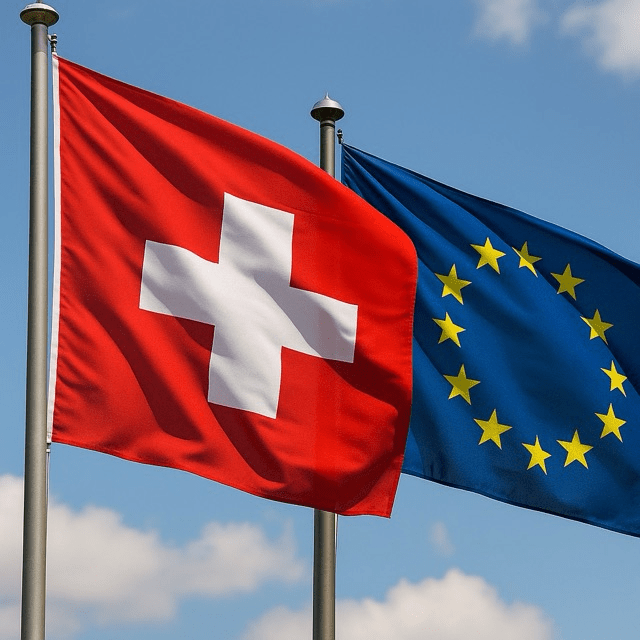
Switzerland’s ongoing negotiations to preserve its privileged access to the European Union’s single market are once again shining a spotlight on the complex, and often controversial, relationship between sovereign states and supranational regulatory frameworks. The new bilateral deal being drafted between Bern and Brussels has surfaced familiar points of contention—many of which mirror the very disputes that plagued the UK-EU relationship during and after Brexit.
The deal, currently under review, is intended to replace a patchwork of more than 120 bilateral agreements that govern Switzerland’s participation in the EU market. But despite Switzerland never having joined the bloc, its deep integration in Europe’s economic architecture has meant that even minor shifts in legal alignment have major political ramifications.
At the heart of the proposed framework are the same thorny issues that became synonymous with the UK’s drawn-out EU departure: regulatory alignment, the role of the European Court of Justice (ECJ), state aid rules, and freedom of movement.
The Swiss government faces domestic pressure to assert national sovereignty, particularly in relation to legal oversight. Many Swiss citizens and political factions are wary of giving any formal role to the ECJ in resolving disputes. “The idea that foreign judges would dictate our legal standards is unacceptable,” said Lukas Reimann, a member of the Swiss People’s Party.
Yet from Brussels’ perspective, uniform enforcement of rules is non-negotiable if Switzerland wants continued access to the single market. The EU insists that regulatory homogeneity and dispute resolution mechanisms are essential for a level playing field.
The debate also extends to the freedom of movement—an issue that led to years of deadlock after a 2014 Swiss referendum called for curbs on EU immigration. The new agreement is expected to reaffirm free movement, raising concerns in Bern about pressure on public services and housing. “We support cooperation, but it must not come at the cost of our social systems,” said Corinne Keller, a local councilor in Zurich.
Analysts say that while Switzerland’s situation is not identical to the UK’s, the core dynamic is the same: how to balance the economic benefits of market access with the political and legal costs of alignment.
“This is essentially Brexit without the exit,” remarked Dr. Fabian Dumas, a political economist at the University of Geneva. “Switzerland wants the privileges without the obligations. The EU has learned from the UK experience and is standing firmer on its red lines.”
Switzerland abruptly walked away from similar negotiations in 2021, citing irreconcilable differences. But growing economic pressure, particularly in the wake of COVID-19 and geopolitical tensions, has renewed Bern’s urgency to strike a deal.
Business leaders are also vocal in their support of an agreement. Swiss exporters and pharmaceutical companies, heavily reliant on EU trade, fear losing competitiveness if regulatory divergence deepens.
“The stakes are high,” said Simone Braun, CEO of a Swiss biotech firm. “We need clarity, we need access, and we need predictability.”
With talks expected to continue into next year, the Switzerland-EU negotiations offer a vivid reminder that the challenges of integrating into the world’s largest trading bloc are far from over—even for countries that never joined it.
As history appears to repeat itself, both sides are navigating familiar terrain—only this time, with Brexit as both a lesson and a warning.




 The Tower Post