Controversial Suggestion Sparks Political and Legal Uproar in Washington and Silicon Valley
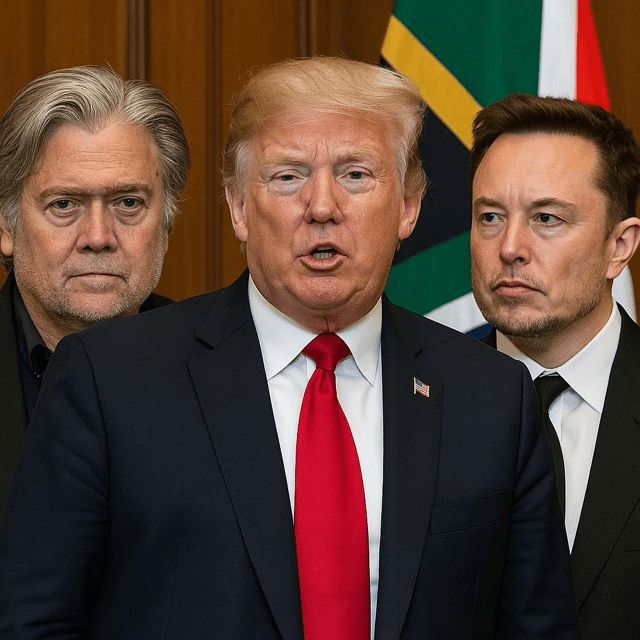
In a stunning twist to the already turbulent political landscape ahead of the 2026 elections, former White House strategist Steve Bannon has reportedly urged Donald Trump to take legal steps to deport tech billionaire Elon Musk back to his native South Africa. The explosive suggestion was made during a closed-door strategy meeting at Mar-a-Lago earlier this week, according to multiple insiders familiar with the matter.
Bannon, known for his aggressive populist views and anti-globalist rhetoric, is said to have framed Musk as a “foreign oligarch meddling in American politics and economics.” The former Breitbart executive reportedly argued that Musk’s influence over media, technology, and even space infrastructure through platforms like X (formerly Twitter), Tesla, and SpaceX constitutes a threat to national interests.
“Elon Musk is not an American patriot. He’s a South African opportunist hijacking our economy,” Bannon allegedly stated, according to a source who attended the meeting. “It’s time we remind him that citizenship is not a shield against accountability.”
The remarks have set off a firestorm in Washington, with legal experts, political analysts, and civil liberties groups condemning the idea as not only unconstitutional but potentially incendiary. Musk, who became a U.S. citizen in 2002, would be protected under immigration and constitutional law unless criminal grounds for revocation of naturalization could be proven — a threshold that has never been applied in cases of political disagreement.
In response, Elon Musk posted a short but pointed message on X: “I’m not going anywhere. Deal with it.”
While Trump has not officially commented on the proposal, sources suggest he listened “intently” and did not dismiss the idea outright. The former president has recently clashed with Musk over their diverging views on artificial intelligence, environmental regulations, and immigration policy. Trump loyalists view Musk’s growing sway among centrists and libertarians as a threat to their grip on the conservative base.
Democrats and moderate Republicans were quick to denounce Bannon’s remarks. Senator Amy Klobuchar called it “a reckless authoritarian fantasy,” while GOP Senator Lisa Murkowski warned of “the dangerous precedent of weaponizing citizenship.”
Despite the backlash, Bannon has doubled down, appearing on his podcast to claim that Musk is “undermining America from within” by “catering to globalist elites and Chinese interests.” He went further to accuse Musk of lobbying against traditional American energy sectors and financing anti-Trump media narratives.
Musk, for his part, continues to portray himself as a champion of free speech and technological innovation, although his acquisition of X and erratic political commentary have made him a lightning rod for controversy. Some insiders believe the friction stems from Musk’s refusal to fully endorse Trump, despite past overtures between the two figures.
Legal scholars note that the deportation of a naturalized citizen without criminal conviction is virtually impossible in modern American jurisprudence. Nevertheless, Bannon’s statement is being seen by many as a symbolic gesture aimed at galvanizing Trump’s nationalist base ahead of what is expected to be a bitterly contested election season.
As tensions escalate between tech elites and populist conservatives, this latest confrontation adds yet another unpredictable twist to an already volatile political climate. Whether or not Bannon’s proposal gains traction, one thing is clear: the war for influence in the next American election is not just being fought in polling stations—it’s playing out on screens, servers, and strategy rooms across the nation.


 The Tower Post