Scientists Make Strides in Achieving Controlled Nuclear Fusion
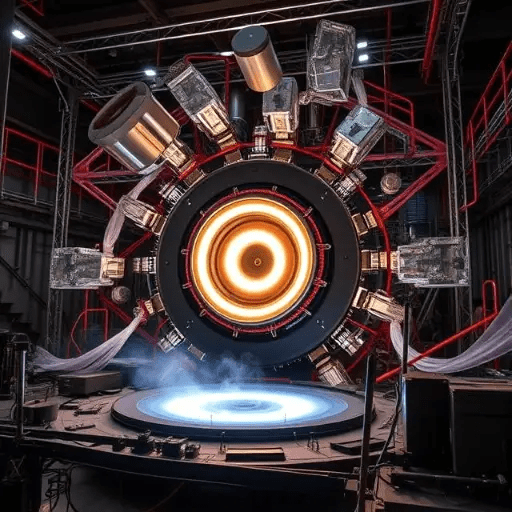
July 2, 2025 – Remarkable advancements from two rival fusion experiments, Germany’s Wendelstein 7-X and the Joint European Torus (JET), have ignited new hope that the long-sought goal of harnessing the power of controlled nuclear fusion may soon be within reach. These record-breaking results suggest that the elusive dream of a virtually limitless and environmentally-friendly energy source could be closer to reality than ever before.
The Wendelstein 7-X, an innovative fusion reactor in Germany, has set a new benchmark by magnetically “containing” a superheated plasma for an astounding 43 seconds – a significant improvement over its previous achievements. Remarkably, the JET reactor near Oxford, England, has reportedly matched this feat, achieving plasma containment times of up to 60 seconds in its final experiments before retiring in December 2023.
These groundbreaking developments have been hailed as a major leap forward in fusion research. “I think it’s probably now about 15 to 20 years [away] from achieving controlled nuclear fusion,” says University of Cambridge nuclear engineer Tony Roulstone. “The superconducting magnets [used in the reactors] are making the difference.”
The Wendelstein 7-X employs a stellarator design, which relies on powerful external magnets to control the plasma, while the JET reactor is a tokamak, which induces an electric current within the plasma to make it more magnetic and prevent it from damaging the reactor chamber. The impressive results from both experiments reinforce the viability of the magnetic confinement approach, though it remains to be seen whether tokamaks or stellarators will ultimately prove to be the superior design.
Notably, private companies are also making significant strides in fusion research, with several firms investing heavily in the development of fusion power plants. One of the most advanced projects is from the Canadian firm General Fusion, which hopes to build a fusion reactor that can feed electric power to the grid by the early to mid-2030s. The company’s chief strategy officer, Megan Wilson, believes that its hybrid “magnetized target fusion” technology has the potential to be the first commercially viable fusion reactor.
While the breakthroughs from the Wendelstein 7-X and JET experiments are undoubtedly promising, numerous challenges still need to be overcome before fusion power becomes a reality. One of the biggest hurdles is the development of superconducting electromagnets, which are cooled with liquid helium to create the powerful magnetic fields essential for controlling the plasma and sustaining fusion reactions.
Despite the challenges, many experts remain optimistic that fusion power is on the cusp of becoming a reality. “The private sector is now putting in much more money than governments, so that might change things,” says University of California, San Diego, nuclear engineer George Tynan. “In these ‘hard tech’ problems, like space travel and so on, the private sector seems to be more willing to take more risk.”




 The Tower Post