With graveyards overwhelmed by months of conflict, families in Gaza are forced to bury their loved ones in hastily dug trenches, as the death toll rises and dignity erodes.
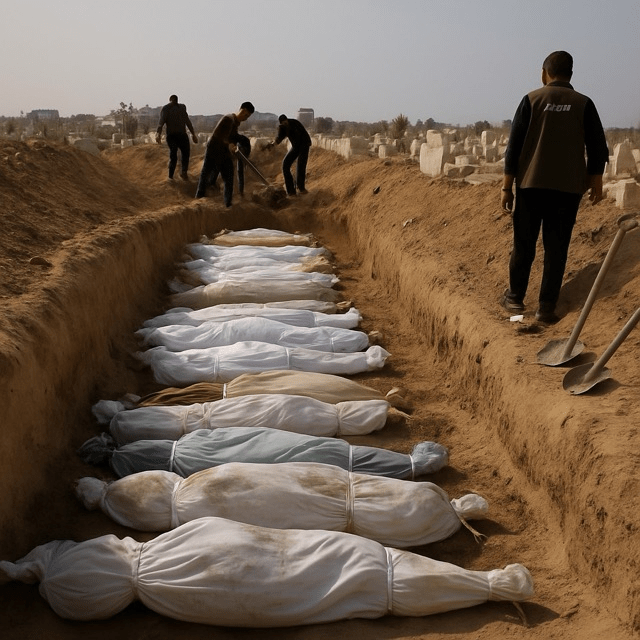
The humanitarian crisis in Gaza has reached a devastating new threshold. As the war grinds on and the death toll mounts, there is no longer room to bury the dead. Cemeteries across the Gaza Strip are overwhelmed, and families are now laying their loved ones to rest in mass graves — a grim and growing testament to the scale of loss.
Once sacred spaces are now scenes of desperation. In central Gaza, bulldozers claw at sandy earth as rows of bodies wrapped in white shrouds are placed side by side in long, shallow trenches. Children, mothers, the elderly — their identities marked only by numbers or handwritten tags.
“There’s simply no space left,” said Ahmed al-Dalu, a gravedigger in Gaza City. “We used to take time for each burial, for prayers and goodbyes. Now we dig with urgency. There’s no choice.”
Hospitals and morgues, already stretched beyond capacity, have become makeshift mortuaries. With the electricity grid shattered and refrigeration unreliable, families rush to bury the dead within hours — often without the rites or ceremonies their traditions demand.
The health ministry in Gaza says the number of fatalities now exceeds 35,000, with thousands still missing under rubble or trapped in no-man’s land. Most cemeteries, especially in heavily bombed areas like Khan Younis and Jabalia, have long since run out of plots.
Aerial imagery confirms what ground witnesses report: common burial sites expanding on the outskirts of towns, often near destroyed hospitals or UN shelters. Aid groups warn of the psychological toll on survivors who must navigate grief amid chaos, with no time or space for mourning.
“Mass graves are not just a sign of logistical collapse — they’re a sign of moral breakdown,” said Clara Mendez, a coordinator for Médecins Sans Frontières in Rafah. “Each one of these bodies had a name, a family, a story. This is not how they were meant to leave this world.”
International law mandates dignified treatment of the dead in conflict zones. But humanitarian corridors remain inconsistent, and security conditions have made the delivery of body bags, burial equipment, and religious personnel near impossible.
Gravediggers now work in rotating shifts, often under bombardment. Some sites are dug with hand tools, others with construction machinery donated or salvaged from rubble. In the absence of coffins, most victims are wrapped in what cloth can be found — sheets, scarves, old uniforms.
Relatives sometimes return days later, placing markers or small flags above the dirt. But many graves remain unmarked, their occupants known only to those who watched them fall.
The UN and Red Crescent have issued renewed calls for an immediate ceasefire and for the protection of civilian infrastructure, including burial grounds. But as fighting continues, Gaza’s landscape is being transformed — not just by destruction, but by the haunting presence of so many lives ended too soon.
“We don’t want statistics,” said Samira Abed, who lost three sons and buried them in a common pit near Beit Hanoun. “We want them to be remembered. We want a place to pray.”
For now, that place is a trench.




 The Tower Post