While global headlines focus on Kyiv and Gaza, dozens of lesser-known wars continue to claim lives and destabilize regions.
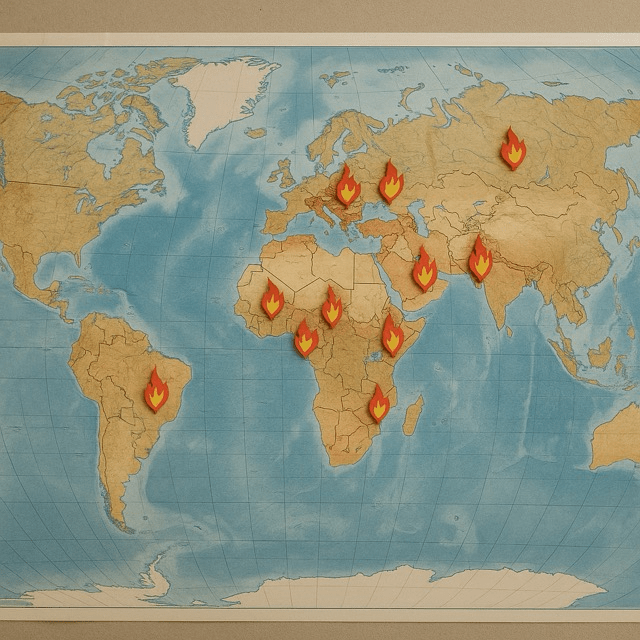
As the world’s attention remains fixed on the war in Ukraine and the escalating conflict in the Middle East, a sobering reality unfolds largely out of sight: 56 armed conflicts are currently active around the globe.
From Africa’s Sahel to Southeast Asia’s highlands, millions of civilians are caught in cycles of violence, displacement, and humanitarian disaster. These forgotten wars — often underreported, sometimes invisible to the wider world — continue to rage, even as the global news cycle narrows its gaze.
According to data from the Uppsala Conflict Data Program and the Armed Conflict Location & Event Data Project (ACLED), the majority of these ongoing conflicts are intra-state or non-international in nature. Many involve state forces battling insurgent groups, ethnic militias, or transnational extremists.
In Africa alone, over 20 armed conflicts persist. Ethiopia’s Tigray crisis, though quieter than at its peak, still festers with unresolved tensions. Sudan, since the 2023 civil war outbreak between the army and the paramilitary RSF, has descended into near-anarchy. The Sahel region — spanning Mali, Burkina Faso, and Niger — remains a hotbed of Islamist violence and military coups.
Meanwhile, in Latin America, Colombia continues to battle dissident rebel factions despite a historic peace deal. In Mexico, cartel wars claim thousands of lives annually, blurring the line between organized crime and armed conflict.
In Asia, Myanmar’s post-coup civil war rages across ethnic regions, while Pakistan grapples with renewed Taliban insurgency. Afghanistan, under Taliban rule, has seen both relative calm and emerging resistance, particularly from groups like ISIS-K. India faces unrest in Kashmir and in several northeastern states.
The Middle East and North Africa remain deeply unstable beyond Gaza and Israel. Syria’s civil war has largely vanished from front pages, yet fighting persists in Idlib and Deir ez-Zor. Yemen’s humanitarian catastrophe, though slowed by ceasefires, is far from resolved.
“There’s a dangerous misconception that peace has returned just because cameras are pointed elsewhere,” says Dr. Leila Mansour, a conflict analyst with the International Crisis Group. “These wars are complex, chronic, and deeply damaging — even when they’re not televised.”
Experts warn that the hyper-focus on major geopolitical flashpoints risks deprioritizing funding and diplomatic attention for other crises. International aid to conflict zones like the Democratic Republic of Congo, the Central African Republic, and Somalia has dwindled as donor fatigue sets in.
Displacement continues to soar. The United Nations reports over 117 million forcibly displaced people worldwide — many from conflicts barely mentioned in international media. Humanitarian corridors remain blocked, and local peace processes stall without external support.
“The world is overwhelmed,” said Jan Egeland, secretary general of the Norwegian Refugee Council. “But that doesn’t make these lives less valuable. Silence is complicity.”
Some conflicts remain deliberately under-reported for political reasons. Others are simply too complex or too remote to capture sustained global interest. But the cumulative human cost is staggering.
As the war in Ukraine drags into another year and the Middle East braces for further escalation, the world would do well to remember that peace is not the absence of noise — it is the presence of justice, diplomacy, and awareness.
Behind every overlooked war is a population longing not for headlines, but for hope.


 The Tower Post