Populist Party Gains Ground Amid Economic Anxiety, Migration Concerns, and Voter Disillusionment
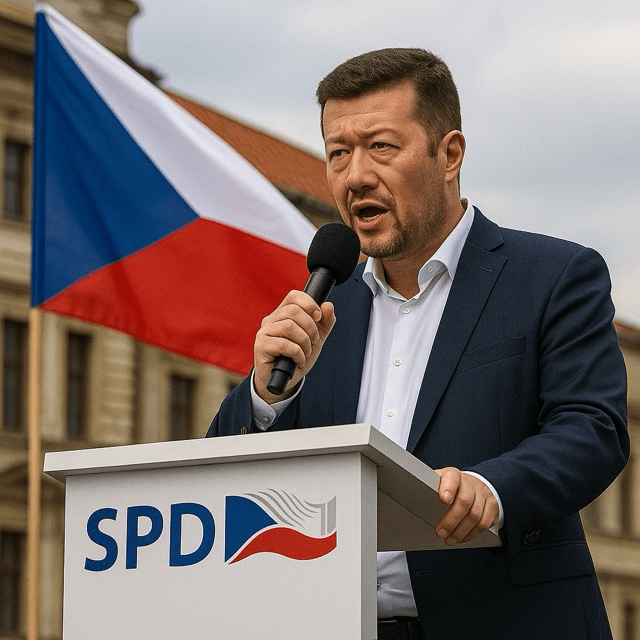
With just months to go before the Czech Republic heads to the polls, the far-right Freedom and Direct Democracy (SPD) party, led by Tomio Okamura, is witnessing a noticeable rise in support. Once considered a fringe force, SPD now appears poised to play a pivotal role in shaping the country’s political future.
Recent opinion polls place SPD among the top contenders, trailing only slightly behind the center-right ruling coalition. The party’s rhetoric—fiercely anti-immigration, anti-EU, and critical of globalism—has resonated with a growing segment of voters fed up with the political establishment.
A Populist Surge
Tomio Okamura, a controversial figure of Czech-Japanese descent, has long pushed for a platform centered on national sovereignty, direct democracy, and hardline immigration controls. His party’s rise is fueled by public discontent over inflation, perceived overreach by Brussels, and dissatisfaction with traditional parties.
“Our country is being dictated to by bureaucrats from the EU while our people suffer from high prices and lack of security,” Okamura said during a recent rally in Brno. “The Czech people deserve to decide for themselves.”
SPD’s message has found particular traction in rural regions and among working-class voters who feel left behind in the post-pandemic recovery.
Challenging the Establishment
The October parliamentary elections will serve as a key test of SPD’s momentum. The current coalition government led by Prime Minister Petr Fiala has struggled with inflation and energy prices, despite recent declines. While the government touts stability and Western alignment, SPD is offering an alternative vision—one that prioritizes Czech sovereignty, reduced EU integration, and stricter immigration rules.
Political analysts warn that even if SPD doesn’t win outright, its increased share of the vote could make it a kingmaker in coalition talks. “We’re looking at a scenario where the SPD could hold enough seats to influence major policy decisions, particularly on foreign relations and migration,” says Dr. Klára Dvořáková, a political scientist at Charles University.
A Divisive Figure
Tomio Okamura remains one of the most polarizing figures in Czech politics. Supporters hail him as a voice for the voiceless; critics accuse him of promoting xenophobia and exploiting fear for political gain. His tough stance on Ukrainian refugees has drawn condemnation from human rights groups but approval from segments of the population exhausted by war-related economic burdens.
SPD’s recent campaign video—featuring burning EU flags and warnings about “Islamization”—was removed from several platforms, sparking a debate over free speech and extremism in Czech political discourse.
October Crossroads
With voter turnout expected to be a deciding factor, both mainstream and fringe parties are doubling down on grassroots campaigns, digital outreach, and door-to-door canvassing. The electoral landscape is fragmented, and no single party is projected to secure a clear majority.
What’s clear is that Tomio Okamura and the SPD are no longer on the sidelines. As economic pressures mount and public frustration deepens, the party’s rise signals a broader shift in Czech politics—one that could echo beyond the October vote.
Whether this marks a temporary protest wave or a lasting realignment remains to be seen. But for now, Okamura’s SPD is capturing the national spotlight—and the attention of Europe.



 The Tower Post