The tech billionaire charts an independent political course, shaking up the U.S. political landscape
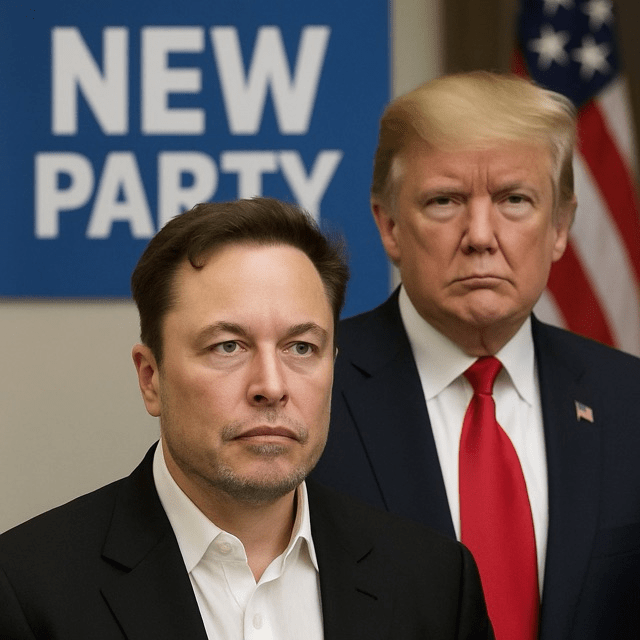
In a dramatic development on the U.S. political stage, Elon Musk has officially severed ties with Donald Trump and is reportedly laying the groundwork for the launch of his own political party ahead of the 2026 midterm elections. The move marks a seismic shift for the billionaire entrepreneur, who had previously offered tepid support to Trump-aligned candidates while promoting a vision of “moderate reform.”
From Fractured Alliance to Political Leap
The relationship between Musk and Trump has long been uneasy—one marked by moments of convergence and tension. Musk left Trump’s business advisory council in 2017 after the former president withdrew from the Paris climate accord. Yet in recent years, the two have found occasional alignment on issues ranging from deregulation to free speech on digital platforms.
But that alignment has come to an end. In a recent interview on X Spaces—Musk’s social audio platform—he stated, “The country needs a new vision, not recycled chaos. We need innovation in governance, not just in technology.”
According to multiple sources close to Musk, the final straw came after private talks in early June 2025, when Trump reportedly pushed Musk to fund and publicly endorse a slate of hard-right candidates. Musk declined, calling the proposal “a step backward.”
The Birth of a New Political Brand
Insiders say Musk’s team is quietly assembling a national network of technocrats, centrists, and disillusioned independents under the working title “The Atlas Movement.” The new party is expected to focus on pragmatic innovation, digital rights, science-led policy, and a radical overhaul of the electoral system.
A formal launch is anticipated by early 2026, with candidates fielded in congressional races across at least 20 states. While Musk has not announced any personal political ambitions, some analysts believe he may endorse a high-profile candidate to lead the charge.
“The United States is overdue for disruption—real disruption—in politics,” Musk said cryptically in a recent post.
Potential Impact and Reactions
The news has already drawn strong reactions from across the political spectrum. Trump loyalists have condemned Musk’s “disloyalty,” while moderate Democrats see the move as a potential spoiler that could siphon votes from both major parties.
Meanwhile, political strategists are split. Some view Musk’s initiative as a billionaire vanity project with little grassroots traction. Others argue it could tap into a growing undercurrent of political dissatisfaction—particularly among younger, tech-savvy voters who distrust traditional institutions.
“Elon Musk is not a conventional politician, and that’s exactly why he might succeed,” says Dr. Nina Hartwell, a political analyst at the Brookings Institution. “The 2026 midterms could be the perfect storm for disruption.”
Silicon Valley Politics Redefined
Musk’s political leap also highlights a growing trend: tech magnates seeking direct influence in policymaking. From Peter Thiel’s funding of conservative candidates to Mark Zuckerberg’s complex entanglements in election security, the lines between Silicon Valley and Washington are increasingly blurred.
Yet Musk’s venture differs in tone and ambition. He appears less interested in pushing a singular ideology than in creating a platform for systemic change—albeit one shaped by his own libertarian-tech worldview.
Conclusion: An Uncharted Course.
Whether Elon Musk’s new political party becomes a lasting force or a short-lived experiment remains to be seen. But the rupture with Trump—and the audacity of a new political movement—is already shaking up the narrative of American politics.
As the 2026 midterm cycle heats up, all eyes will be on the Atlas Movement—and on the man who has never been afraid to rewrite the rules.




 The Tower Post