On July 7, former president escalates trade tensions with bold move targeting key Asian allies
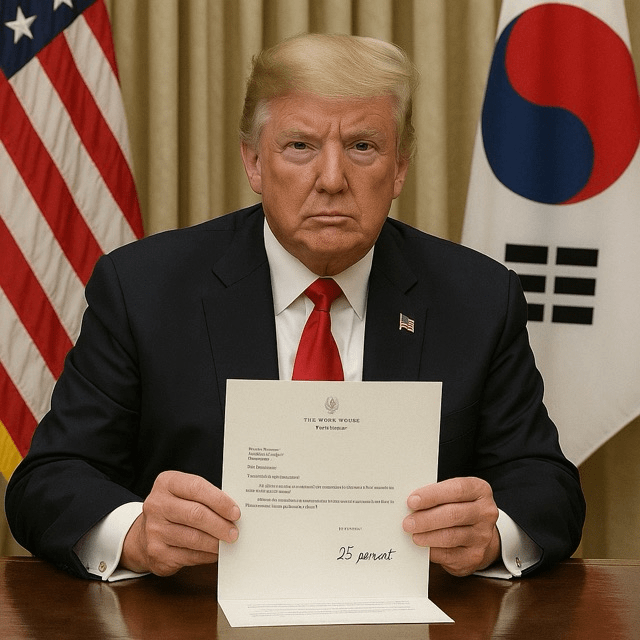
In a dramatic escalation of his protectionist trade agenda, former U.S. President Donald Trump reportedly sent formal letters to the governments of Japan and South Korea on July 7, declaring his intention to impose 25% tariffs on a broad range of goods if key trade imbalances are not addressed. The move, first revealed by sources close to Trump’s campaign team, has sent shockwaves through global markets and reignited concerns over a renewed trade war in Asia.
Letters That Sparked Panic
According to diplomatic insiders, the letters—delivered through informal diplomatic back channels—were addressed directly to Japanese Prime Minister Fumio Kishida and South Korean President Yoon Suk-yeol. The documents outlined Trump’s grievance over persistent trade deficits and what he described as “unfair subsidies and dumping practices” harming American industries.
In the letters, Trump threatened to enact a blanket 25% tariff on imported automobiles, electronics, and steel products—three sectors where both countries maintain strong exports to the U.S. The action, he claimed, would “protect American jobs and restore fair play.”
Tokyo and Seoul Caught Off Guard
Japanese and South Korean officials were reportedly blindsided by the messages. Neither government had been formally briefed by the current Biden administration about Trump’s renewed trade ambitions, nor were they expecting direct communication from a former president.
“We are assessing the authenticity and implications of the communication,” a senior Japanese trade official said. “Any unilateral tariff action would destabilize regional economic cooperation and violate WTO protocols.”
In Seoul, a spokesperson for the presidential office noted “deep concern” and emphasized South Korea’s commitment to open trade and strategic cooperation with the United States.
Economic and Political Ripples
Markets reacted quickly. Asian stock exchanges dipped the following morning, with auto manufacturers and tech exporters seeing immediate declines. The Japanese yen and South Korean won also slid slightly against the dollar as investor anxiety spiked.
Political analysts say Trump’s move is a signal to his base ahead of the 2026 midterm elections. “This is classic Trump—creating headlines, asserting dominance, and positioning himself as the defender of American manufacturing,” said Henry Cole, a senior fellow at the Atlantic Council.
The letters could also serve to pressure the Biden administration to adopt more aggressive trade tactics—a dynamic reminiscent of Trump’s 2018 tariff battles with China.
Legal and Diplomatic Questions
While Trump holds no official authority as a private citizen, the seriousness of the letter’s content has raised questions in diplomatic and legal circles. “It’s highly unusual, possibly unprecedented, for a former president to engage in unofficial trade negotiations or threats of tariffs,” said Rebecca Miles, a professor of international law at Georgetown University.
Experts say the U.S. government may be forced to clarify that Trump’s letters do not represent official U.S. policy—though the political calculus of doing so remains complex.
What’s Next?
The governments of Japan and South Korea are said to be consulting with their U.S. counterparts while considering formal responses. Trade ministers from both countries are expected to meet in Geneva next week during WTO discussions, where the issue will likely be raised behind closed doors.
Meanwhile, Trump’s campaign continues to highlight the letters as a bold act of “economic leadership.” In a statement on Truth Social, Trump declared, “America will no longer be the world’s piggy bank.”
Conclusion
Whether this is a strategic maneuver or a precursor to deeper trade ruptures, one thing is clear: Donald Trump has reinserted himself into the global economic conversation—uninvited, but impossible to ignore.

 The Tower Post