President’s relationship with the Kremlin under fresh criticism as geopolitical tensions escalate
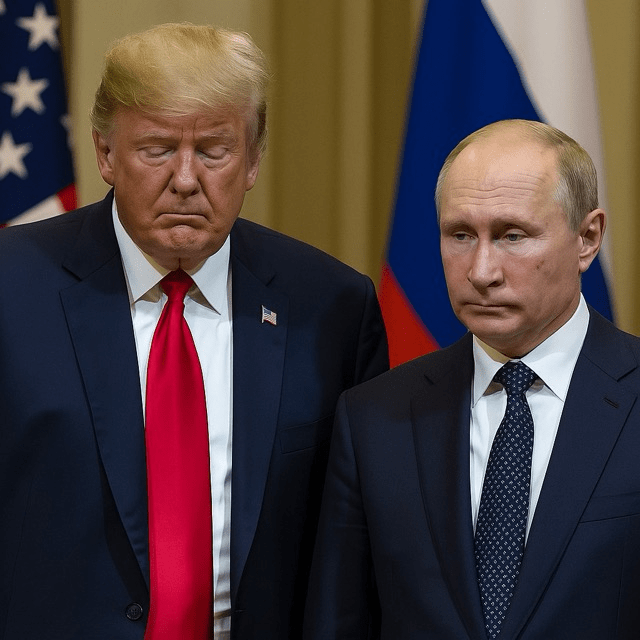
Trump’s Misplaced Trust in Putin Raises Renewed Scrutiny
President’s relationship with the Kremlin under fresh criticism as geopolitical tensions escalate
Washington — As the geopolitical landscape continues to shift amid the war in Ukraine and Russia’s increasingly confrontational posture toward the West, U.S. President Donald Trump is facing renewed scrutiny over his longstanding deference to Russian President Vladimir Putin.
Critics argue that Trump’s trust in Putin — often expressed during his presidency through controversial statements and softened rhetoric — may have emboldened the Kremlin at a critical time. Analysts now suggest that Trump’s policies and diplomatic posture toward Russia failed to anticipate or deter Moscow’s aggressive moves, particularly its 2022 invasion of Ukraine.
“Trump misjudged Putin’s intentions,” said retired U.S. Ambassador William Brooks. “His belief that he could forge a personal bond with Putin led to a series of diplomatic miscalculations that weakened Western unity.”
Perhaps the most infamous example came during the 2018 Helsinki summit, where Trump publicly sided with Putin over U.S. intelligence agencies regarding Russian interference in the 2016 election. The moment was widely condemned across the political spectrum, with even some Republican lawmakers calling it a “low point” in American diplomacy.
Trump repeatedly praised Putin as a “strong leader” and questioned NATO’s relevance, sowing division among U.S. allies. While his administration did impose sanctions on Moscow and approved lethal aid to Ukraine, Trump’s personal posture appeared at odds with the strategic interests of the West.
Now, with Russia entrenched in a bloody war against Ukraine and tensions mounting with NATO, critics say the consequences of Trump’s miscalculations are coming into sharper focus. “When a U.S. president sends mixed signals, adversaries take advantage,” said Fiona Hill, a former National Security Council official under Trump. “Putin saw opportunity in the ambiguity.”
In recent interviews, Trump has doubled down on his earlier stance, claiming that his rapport with Putin “kept the peace” and that “none of this would have happened if I were still in office.” His supporters argue that Trump’s unpredictability was a deterrent, not a weakness.
But many foreign policy experts remain unconvinced. They argue that Trump’s personal admiration for authoritarian leaders undermined institutional checks and led to diplomatic confusion. “Trusting Putin was not just a naïve mistake,” said political scientist Dr. Lena Marcus. “It was a strategic failure with long-term implications.”
With Trump once again the frontrunner in the Republican primary for 2024, his foreign policy record is under renewed examination. The question now is whether American voters — and global leaders — view his approach to Russia as bold diplomacy or dangerous indulgence.
As the war in Ukraine rages on and global alliances are tested, one truth becomes increasingly clear: history is unlikely to look kindly on the trust Trump placed in Vladimir Putin.


 The Tower Post