As deals between Rome and Brussels push enforcement southward, sub-Saharan migrants are trapped in a humanitarian nightmare in Tunisia’s olive orchards.
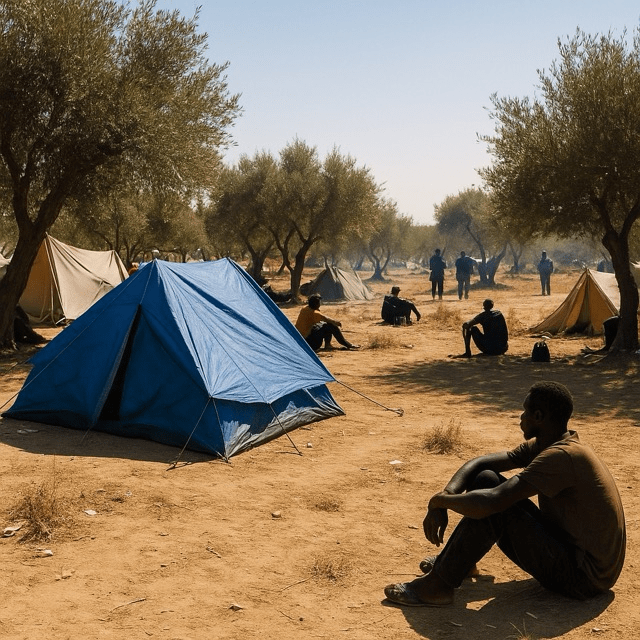
In the wake of a landmark 2023 agreement between Italy and the European Union aimed at curbing migration across the Mediterranean, Tunisia has become the frontline of a new and brutal enforcement regime. What was heralded in Brussels and Rome as a strategic victory in the fight against unauthorized arrivals has, on the ground, produced a humanitarian catastrophe transforming Tunisia’s olive groves into a vast open-air prison for thousands of vulnerable men, women, and children.
Since the deal was struck—an accord that saw Italy secure heightened border patrols and coast guard patrols funded by EU resources—Tunisian authorities have embarked on sweeping clearance operations targeting makeshift camps of sub-Saharan migrants. In early April 2025, police in batons marched along dirt tracks flanked by ancient olive trees, setting fire to tents and driving families from one olive orchard to the next. Eyewitnesses describe scenes of panic as migrants, many of them without shoes or warm clothing, sprinted through groves thick with gnarled trunks, carrying only what little they could salvage from the blaze.
The clearance efforts have particularly concentrated in the Sfax region, where an estimated 20,000 migrants had sought refuge amid the shade of olive trees just a few kilometers from the Mediterranean coast. Frustrated landowners and local officials, backed by tacit approval from the central government, have viewed the informal camps as threats to both public health and private property. “They came without permission, they lived on private land,” said one local landowner. “We had to reclaim our orchards.” Yet critics argue that these actions amount to collective expulsion and warn of dire consequences for those uprooted without safe alternatives.
Humanitarian organizations report that once evicted, many migrants are abandoned in remote olive groves far from any settlements, their food and water supplies destroyed or confiscated by Tunisian forces. Lacking formal camps or official shelters, they eke out survival in the shadows of olive canopies, exposed to the elements and vulnerable to patrolling militia and smugglers alike. One young man from Niger recounted spending three nights huddled beneath a tree after fleeing a raid, too weak to flee further. “There was no help, no water,” he told an aid worker. “It was hell.”
In response to mounting international criticism, the European Commission announced in January 2025 a fundamental overhaul of its funding arrangements with Tunisia. Following an investigation by the Guardian that exposed widespread abuses—ranging from beatings to sexual violence—by security forces financed by EU payments, Brussels pledged to condition future disbursements on strict human rights benchmarks. “We will not tolerate violations of human dignity,” said an EU spokesperson, outlining new clauses to suspend funds in cases of documented abuse.
Yet for the migrants already caught in this crossfire, policy revisions in Brussels arrive too late. Voluntary repatriation programs have faltered, as many fear persecution or violence if returned home, while others still dream of reaching Europe. Smugglers, sensing opportunity in the chaos, continue to charge exorbitant fees to facilitate perilous sea crossings from Tunisia’s shores. According to the International Organization for Migration, arrivals to Italy from Tunisia dropped by 82% since 2023, but irregular departures remain, and those intercepted at sea risk being pushed back to Tunis, perpetuating the cycle of displacement.
Amidst this crisis, aid agencies struggle to maintain access. Tunisian authorities have prosecuted activists providing legal or medical assistance, labeling them as complicit in human trafficking. Clinics once scattered throughout coastal towns have closed, and legal aid offices in Tunis have been raided. The human rights community warns that silencing defenders not only violates Tunisian law but undermines any hope of transparency or accountability.
As autumn approaches and the olive harvest draws near, the groves—symbolic of Tunisia’s ancient agrarian heritage—stand witness to a modern tragedy. Tens of thousands of migrants, displaced from Libya, Mali, and beyond, are trapped in an olive-tree labyrinth under the scorching Mediterranean sun. With no clear path forward and mounting political pressure on both Rome and Brussels to uphold their hardline stance, the olive groves have become emblematic of Europe’s unwillingness to share responsibility for the global migration challenge.
This unfolding drama poses urgent questions: Can the EU enforce its human rights commitments without dismantling its migration framework? Will Italy continue to press for stricter controls at the expense of humanitarian safeguards? And most critically, will the plight of those suffering under olive branches finally move policymakers to seek a more balanced, compassionate approach—or will ruthless geopolitics continue to consign migrants to this living hell?




 The Tower Post