Four in Ten Flights Delayed or Canceled; Ryanair Plummets from Best to Worst Performer
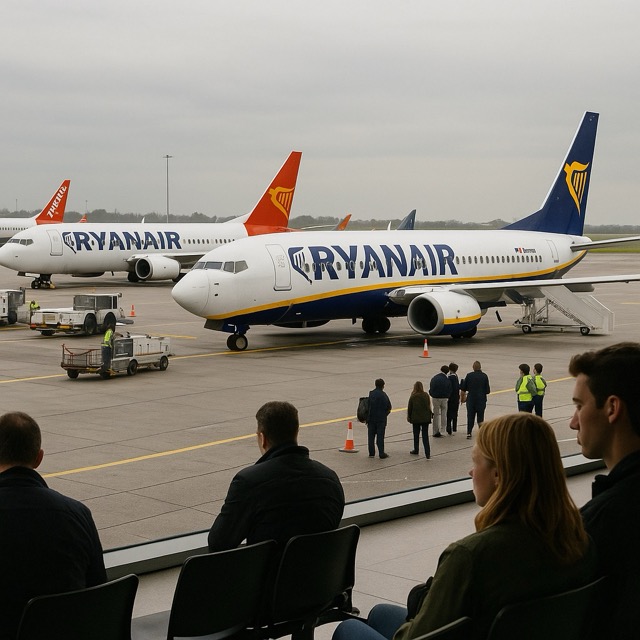
Europe’s air traffic woes deepened in 2025 as new data revealed that four out of every ten flights were either delayed or cancelled. The figures, compiled by aviation analytics firm FlightStats, indicate a sharp deterioration in operational performance across the continent’s major hubs and carriers, leaving millions of passengers frustrated and questioning the resilience of Europe’s aviation infrastructure.
Analysts point to a confluence of factors driving the surge in disruptions: air traffic control understaffing, congested airspaces, and a shortage of qualified pilots and ground personnel. At Frankfurt, Europe’s busiest airport, average delays topped 45 minutes per flight in June, up from 28 minutes a year earlier. Similar trends have been reported at Paris Charles de Gaulle, Amsterdam Schiphol, and London Heathrow.
Low-cost carrier Ryanair, long celebrated for punctuality and cost efficiency, saw its on-time performance plummet. In early 2024, Ryanair was ranked among the top three punctual European airlines; by mid-2025 it held the unenviable position at the very bottom of the list. The Dublin-based airline cited storm-related disruptions and aircraft rotations cascading across congested routes, yet critics argue that aggressive scheduling and tight turnaround windows have left Ryanair especially vulnerable.
Passenger sentiment has soured. In a survey conducted by Consumer Aviation Watch, 62% of respondents rated their 2025 flying experience in Europe as “poor” or “very poor,” compared to 38% in 2023. Complaints center on missed connections, lost baggage, and inadequate compensation. Under EU Regulation 261/2004, passengers whose flights are delayed by more than three hours or cancelled without proper notice are entitled to financial reimbursement; however, many carriers struggle to process claims promptly.
Air traffic management (ATM) authorities are under intense pressure to modernize systems and recruit additional controllers. EUROCONTROL, the pan-European agency responsible for coordinating cross-border traffic, warned that the current network is operating beyond design capacity. “We are seeing record-high demand without corresponding investment in infrastructure,” said EUROCONTROL’s director general. “Without immediate action, delays will only worsen.”
Budget airlines blame recurring ATC strikes as a leading cause of cancellations. In May 2025, French and Italian controllers staged walkouts over pay disputes, paralyzing large swaths of European airspace. While governments negotiated back-to-work agreements, the backlog of flights took weeks to clear, compounding operational inefficiencies at airports and with aircraft scheduling.
Lufthansa Group, which includes SWISS and Austrian Airlines, reported a 12% increase in operational costs related to delays and rebookings in the first half of 2025. The group’s CEO called for harmonized strike regulations and greater flexibility in rerouting options. “Europe’s fragmented policy framework only exacerbates disruptions,” he remarked at a press conference in Berlin.
Passengers have adapted by building larger buffers into travel itineraries and favoring airlines with robust snack-on-board compensations. Some have turned to alternative modes of transport, notably high-speed rail, for short-haul routes. The EU has responded by expanding rail corridor funding, seeking to alleviate pressure on congested airports.
Looking ahead to the peak summer season, industry watchers note that without significant improvements in ATM staffing and collaborative decision-making, the 2025 disruption levels could become the new normal. Calls for a unified European aviation strategy, encompassing staffing, technology upgrades, and passenger rights enforcement, are growing louder.
As Europe’s skies remain turbulent, the airline and regulatory community face a pivotal moment. Will they rise to the challenges of modern aviation demand, or will passengers continue to endure the headaches of delays and cancellations? The answer will shape the future credibility of Europe’s aviation sector.




 The Tower Post