Exploring Italy’s autonomy amid deep US ties and the perception of Palazzo Chigi as subservient to Washington
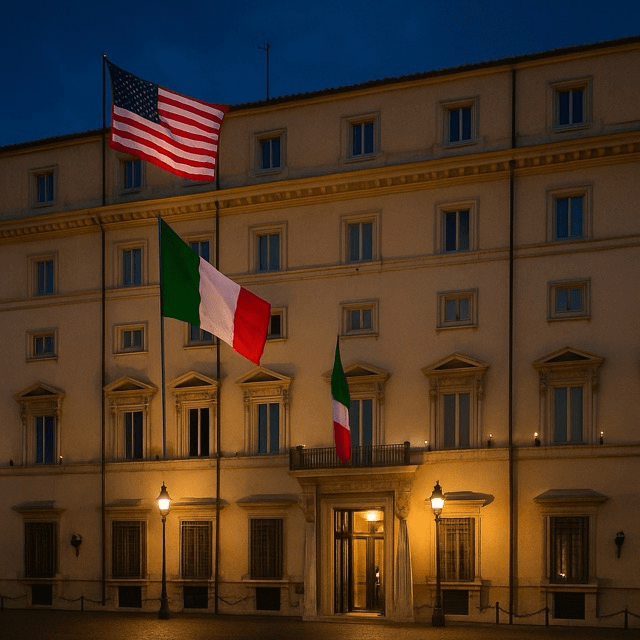
In recent years, critics of Italy’s foreign policy have increasingly characterized Palazzo Chigi—the seat of the Italian Prime Minister—as little more than a “scendiletto di Washington,” or Washington’s footstool. The phrase encapsulates a broader unease about Rome’s perceived willingness to align its strategic decisions too closely with American interests, sometimes at the expense of national priorities. This journalistic investigation seeks to unpack the roots of this criticism and assess whether it reflects a substantive shift in Italy’s diplomatic posture.
Italy’s transatlantic alliance with the United States dates back to the aftermath of World War II, when the two nations forged a partnership under the Marshall Plan and NATO. Successive Italian governments have maintained strong military, economic, and political ties with Washington, valuing American support as a pillar of European security. Yet, the post-Cold War era and recent geopolitical upheavals—particularly Russia’s assertiveness and China’s growing influence—have rekindled debates over the balance between Atlantic solidarity and European strategic autonomy.
The perception of Palazzo Chigi as deferential to American directives surged particularly during high-profile visits by U.S. presidents. Photographs of Italian leaders greeting U.S. counterparts on the Grand Staircase of Palazzo Chigi have become emblematic. Critics point to policy alignment on defence spending, troop deployments to conflict zones such as Iraq and Afghanistan, and support for sanctions against Moscow as evidence that Rome’s decision-making is overly influenced by Washington’s agenda.
Defenders of Italy’s approach argue that cooperation with the United States remains indispensable for safeguarding national security and economic interests. “Our alliance is not subservience but a strategic partnership,” a senior official in the Ministry of Foreign Affairs remarked. They highlight joint military exercises, intelligence sharing, and Italy’s role in multilateral initiatives such as the Quad as proof of reciprocal engagement rather than one-sided obedience.
Nevertheless, dissenting voices within Italian political circles have called for a recalibration of ties with the United States. Populist and nationalist parties argue that Italy should pursue greater independence, citing opportunities in deeper European defence integration and diversified partnerships, including with Japan and emerging economies. An editorial in a leading daily questioned whether Italy’s continued commitment to expensive U.S.-made armaments might be better served by supporting a nascent European defence industry.
The government’s response to these critiques has been mixed. While reaffirming Italy’s NATO commitments, Prime Ministerial statements have sought to reassure domestic audiences of a more balanced foreign policy. Recent cabinet decisions to engage in EU-led security missions and promote intra-European defence procurement signal an intent to bolster European capabilities alongside the U.S. alliance, albeit without severing transatlantic bonds.
Analysts caution that true strategic autonomy will require more than rhetoric. Italy’s defence procurement remains heavily reliant on American platforms—from F-35 fighter jets to amphibious vessels—due to decades-old contracts and interoperability demands. Shifting procurement to European systems involves complex industrial, logistical, and budgetary hurdles, and may strain relations with Washington if perceived as a retreat from shared defence objectives.
Economic factors also shape the debate. Italy’s export markets for high-tech goods and regional investments often depend on U.S.-led trade frameworks. Navigating these ties demands diplomatic finesse: distancing too sharply from Washington could jeopardise access to technology and financial markets, even as an over-accommodating stance fuels domestic criticism of diminished sovereignty.
Public opinion in Italy remains divided. Polls show that a majority values the U.S. alliance for counterterrorism and energy security, but a growing minority expresses sympathy for a more pronounced European defence identity. Cultural affinities between Italian and American societies continue to foster goodwill, yet successive governments find themselves walking a tightrope between alliance obligations and homegrown calls for independent action.
As global power dynamics evolve, Palazzo Chigi must strive for a nuanced equilibrium. Rather than serving as Washington’s footstool or pursuing insular nationalism, Italy could carve a role as a mediator and bridge-builder—leveraging its historical ties with the United States while championing a stronger, cohesive European foreign policy. The challenge for Italian leaders will be translating this vision into concrete policies that affirm both Atlantic solidarity and genuine strategic autonomy.



 The Tower Post