Brussels presses Paris to back a pact uniting 700 million consumers amid rising protectionism
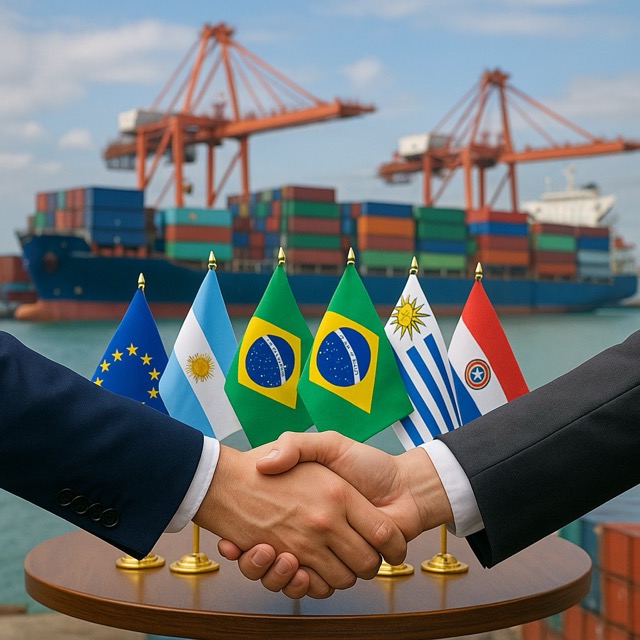
BRUSSELS, July 19, 2025 — The European Commission has intensified efforts to secure France’s endorsement of a long‑awaited trade agreement with the Mercosur bloc, whittled down after more than two decades of negotiations. If ratified, the deal would integrate the EU market of 450 million people with Brazil, Argentina, Uruguay and Paraguay, jointly representing some 700 million consumers and creating one of the world’s largest free‑trade areas.
For French President Émile Durant, the agreement presents both opportunity and risk. While it promises to open new outlets for French wine, cheese and other agro‑industrial goods, Paris is wary of an influx of cheaper agricultural imports — beef, sugar and ethanol — that could undercut domestic producers. French farmers, a potent political lobby, have staged protests in recent weeks demanding stronger safeguards and compensation measures.
Commission President Ursula von del Leyen, speaking at a trade summit in Brussels, appealed directly to French lawmakers. “This pact embodies our commitment to diversify partnerships, boost economic growth and reinforce geopolitical autonomy,” she said. “We have incorporated robust sustainability clauses and rigorous sanitary‑phytosanitary standards that respect environmental and labour norms.”
Despite these assurances, several EU capitals have come out in support of Paris’s precaution. Germany and Spain, both keen on exporting machinery and olive oil, have offered to help co‑finance transition schemes for farmers affected by increased competition. The European Parliament is expected to vote on the ratification package in September, putting pressure on France to clarify its stance before the legislature reconvenes.
In Paris, Agriculture Minister Clémence Dubois convened meetings with farm unions and trade officials to iron out concession packages. Dubois emphasized that any ratification must be “contingent on binding guarantees” — including tariff quotas on Mercosur beef and enhanced funding for rural development programs. Observers note that France’s final decision could set a precedent for other hesitant member states.
Mercosur representatives have welcomed the French outreach. Brazilian Trade Minister Rafael Costa told Reuters, “We appreciate France’s leadership within the EU and believe a balanced agreement will deliver benefits across all sectors. Our economies complement one another, and we stand ready to meet France’s concerns with technical dialogue.”
The renewed push in Brussels is widely seen as a direct response to the return of Donald Trump to the White House, whose administration has signalled a more protectionist trade posture. By diversifying its portfolio of partners, the EU hopes to reduce over‑dependence on the United States and guard against abrupt policy shifts across the Atlantic.
With its strategic importance underscored by global volatility, the Mercosur deal has become a litmus test for European unity on trade. As July progresses, all eyes will be on Paris to see whether it will seize what proponents call a historic chance to deepen ties with dynamic South American markets — or hold firm in defence of its farmers’ interests.

 The Tower Post