Study Reveals Surge in Overseas Deals, Highlighting Beijing’s Growing Engagement Compared to US Approach
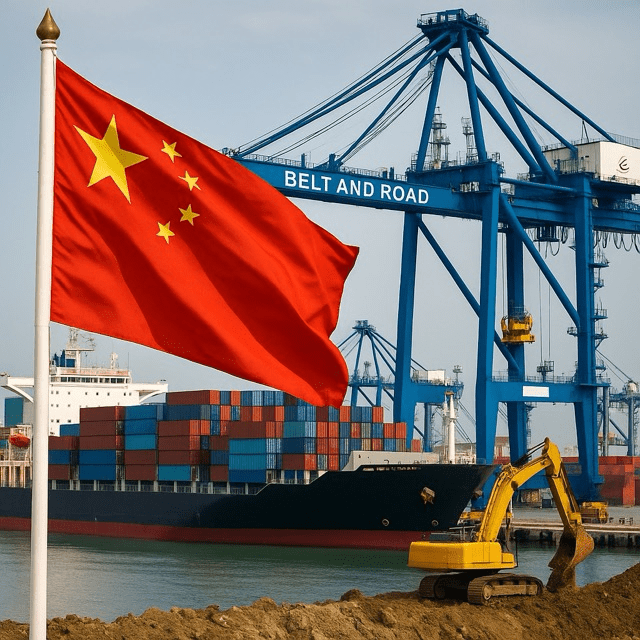
A new study has found that investment and construction activity under China’s Belt and Road Initiative (BRI) reached an unprecedented $124 billion across 176 deals in the first half of 2025. The report, published by the Global Infrastructure Tracker, underscores Beijing’s unwavering commitment to expanding its economic footprint in Asia, Africa, Europe, and Latin America, even as the United States has adopted a more cautious stance toward infrastructure partnerships.
According to the study, BRI investment spanned a diverse range of sectors, including transportation networks, energy plants, and digital infrastructure. Rail and port projects accounted for nearly 40% of total deal value, with flagship ventures such as the Kuala Lumpur–Singapore high-speed rail and a deepwater port in southern Pakistan alone representing close to $30 billion. Energy investments—including power plants in Bangladesh and renewable energy parks in Kenya—added another significant share.
“We are witnessing remarkable momentum in BRI activity,” said Dr. Helena Zhang, lead author of the report. “Despite global economic headwinds, China is doubling down on its infrastructure diplomacy, using state-backed financing and contractor expertise to secure strategic partnerships. This contrasts sharply with the United States, which has retreated from large-scale overseas infrastructure funding.”
The study highlights that more than half of BRI deals in the period benefited from concessional loans provided by policy banks such as the China Development Bank and the Export-Import Bank of China. These financial instruments, often tied to Chinese engineering firms, have enabled swift project mobilization, albeit amid concerns over debt sustainability in recipient countries.
In Africa, China accounted for over $25 billion in new commitments, notably financing the expansion of the Mombasa–Nairobi Standard Gauge Railway in Kenya and constructing a coal-fired power station in Nigeria. European recipients, including Greece and Serbia, saw investments focused on upgrading rail corridors and port facilities to integrate with wider EU transport networks.
Meanwhile, in Latin America, China inked deals worth $15 billion, backing a gas pipeline in Colombia and a digital connectivity project in Brazil’s inland regions. The rapid proliferation of these projects has cemented China’s role as a leading development partner, challenging traditional Western donors and multilateral institutions.
By comparison, U.S.-led initiatives such as the Build Back Better World (B3W) program have struggled to gain traction. Launched in 2021, B3W aimed to mobilize private capital for infrastructure in lower-income countries, but critics point to its slow start and lack of binding financing commitments. “The gap between rhetoric and reality is evident,” observed Luis Ramirez, a policy analyst at the Center for Global Development. “BRI’s streamlined, state-driven model offers a stark alternative to multilateral financing mechanisms.”
The report’s findings have prompted debate over the geopolitical implications of China’s infrastructure push. Observers warn that the heavy involvement of Chinese firms in strategic sectors could translate into long-term influence, particularly in countries with fragile governance. Conversely, proponents argue that BRI projects deliver much-needed development benefits and can be structured to mitigate debt risks.
In response to growing scrutiny, Beijing has announced measures to increase transparency and promote high-quality projects. At the recent Belt and Road Forum in Beijing, President Xi Jinping underscored a shift toward “commercially viable and environmentally sustainable investments,” pledging to collaborate more closely with host nations to ensure projects align with local priorities.
Analysts caution, however, that the success of these reforms will depend on implementation and recipient capacity. “Transparent procurement processes and independent feasibility studies are essential,” said Professor Markus Weber of the European School of Governance. “Without them, the risk of cost overruns and governance failures remains high.”
Looking ahead, the report forecasts that BRI transactions could surpass $250 billion by year-end, driven by large-scale energy and transport corridors. As China deepens its global footprint, the international community faces a choice: engage with Beijing’s model, reform existing institutions to compete, or pursue hybrid approaches that blend public and private resources.
For policymakers and market participants, the study serves as a reminder of BRI’s enduring appeal and the challenges it poses to established development paradigms. Whether the U.S. and its allies will respond with comparable scale or seek targeted partnerships remains a topic of intense discussion as the world grapples with infrastructure needs, climate goals, and shifting power dynamics.




 The Tower Post