A New Era in AI-Powered Entertainment and Education

Hugging Face, a leading AI developer platform, has made a significant foray into the robotics market with its Reachy Mini robots. Just five days after opening orders, the company has reportedly logged $1 million in sales, a promising start for a venture that has expanded into a new area. Founded in 2016 by Thomas Wolf, Hugging Face has established itself as a major player in the AI space, with a focus on making AI more accessible and user-friendly.
Hugging Face’s flagship product is its transformer-based models, which have become the de facto standard for natural language processing tasks. The company’s models, such as BERT and RoBERTa, have been widely adopted in the industry and have achieved state-of-the-art results in various NLP tasks. Hugging Face’s models are also highly customizable, allowing developers to fine-tune them for specific tasks and domains.
In addition to its models, Hugging Face has also developed a range of tools and libraries for building and deploying AI applications. Its Transformers library, for example, provides a simple and intuitive interface for using transformer-based models in a variety of tasks. The company has also developed a range of other tools, including datasets, pre-trained models, and model cards, to make AI development more accessible to developers of all levels.
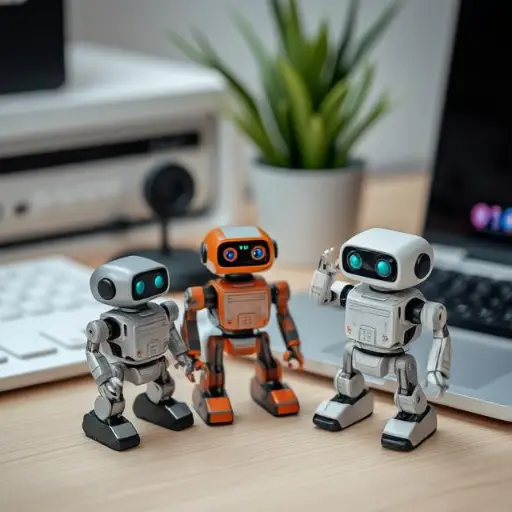
Hugging Face’s entry into robotics with the Reachy Mini represents a significant expansion of the company’s offerings into the physical world. The Reachy Mini, a compact robot designed to fit on a desk, boasts an array of features, including two misshapen eyes with cameras, microphones, speakers, and a head that bobs around, all connected by a pair of antennas. While other startups focus on robots that can offload household chores, Hugging Face sees the Reachy Mini as an entertainment device that can be hacked and customized by users. Wolf likened the device to an “empty iPhone,” hinting at the massive market potential for AI-powered robots.
The Reachy Mini has garnered significant attention since its launch, thanks to its friendly design and relatively affordable price point. Wolf believes that this approach is key to making AI-powered robots accessible to consumers, making them comfortable with the technology and earning their trust. He envisions the Reachy Mini as an entry point for people to learn about open-source software and the potential of AI.
Wolf’s vision for the Reachy Mini is not limited to entertainment; he also aims to build a network of apps for the device, allowing users to create and share their own applications. This approach could foster a community of developers and enthusiasts, driving innovation and adoption of open-source AI.
The acquisition of the French robotics startup Pollen by Hugging Face is another significant development in the company’s robotics endeavors. Wolf’s emphasis on developing robots at a low price point suggests that Hugging Face is committed to making AI-powered technology accessible to a broader audience.
As the AI industry continues to evolve, open-source AI is poised to play a crucial role in robotics, much like it has in software development. Hugging Face is well-positioned to capture this interest, with its expertise in AI development and its commitment to making technology accessible to all.
The Reachy Mini may have started as a novelty, but it has the potential to revolutionize the way we interact with AI and robotics. As the company continues to push the boundaries of what is possible, one thing is clear: Hugging Face is bringing open-source AI to life, and it’s just the beginning.