Historic Agreement to Boost Co-Production and Export of Eurofighter Typhoon Jets and Other Systems
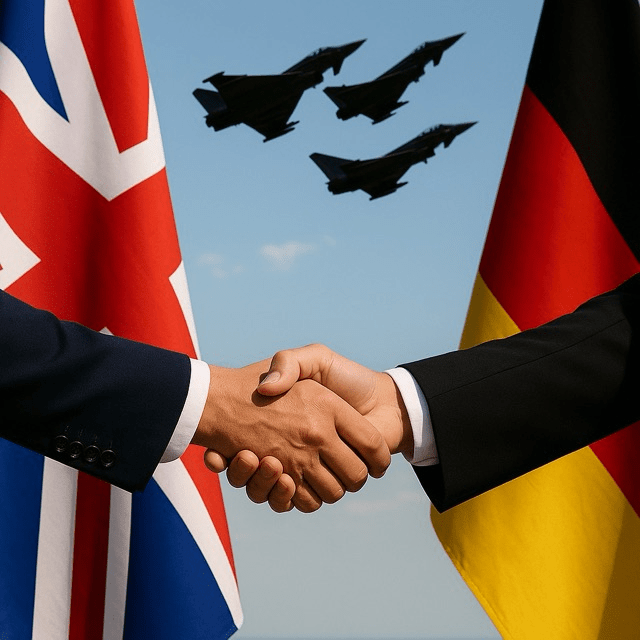
London/Berlin – In a landmark development for European defence cooperation, the United Kingdom and Germany will sign a comprehensive pact today aimed at enhancing joint marketing and sales of co-produced military hardware, most notably the Eurofighter Typhoon combat aircraft. The agreement, to be inked by UK Defence Secretary Rachel Jones and German Minister of Defence Klaus Richter in Berlin, marks a strategic deepening of ties between two leading NATO powers amid shifting global security challenges.
The fledgling alliance, dubbed the Anglo-German Defence Partnership, seeks to streamline export procedures, consolidate marketing efforts, and present a unified sales front to customers in the Middle East, Asia-Pacific, and elsewhere. By leveraging the UK’s established defence export networks and Germany’s industrial capacity, both nations hope to secure lucrative contracts for the Typhoon and other collaborative platforms, including missile systems, radar suites, and advanced training simulators.
Under the new framework, a joint steering committee will oversee shared responsibilities: the UK’s Defence Equipment Sales Office will handle outreach to prime aviation customers, while Germany’s Federal Office of Bundeswehr Equipment, Information Technology and In-Service Support will coordinate technical integration and after-sales support. A unified export licence regime is also on the table, designed to reduce bureaucratic delays by synchronising the regulatory processes of both capitals.
“This pact represents a powerful signal of Anglo-German solidarity at a time when our adversaries are modernizing their arsenals at pace,” said Defence Secretary Jones. “By combining our strengths, we enhance interoperability, economies of scale, and our ability to deliver cutting-edge systems to partners and allies around the globe.”
Minister Richter echoed those sentiments: “Germany and the UK have a proud history of defence collaboration. Today’s agreement builds on decades of industrial cooperation, ensuring that Eurofighter remains a world-class solution. We are also laying the groundwork for future programs, from next-generation unmanned systems to integrated air defence architectures.”
The pact arrives against the backdrop of rising global tensions—from the Indo-Pacific theatre to renewed great-power competition in Europe. NATO’s Secretary General has welcomed the move, noting that closer bilateral defence ties reinforce the Alliance’s collective deterrence posture. It also offers a template for deeper European collaboration, potentially easing the path for more unified continental defence initiatives in the years ahead.
Industry leaders on both sides of the Channel have hailed the agreement. Eurofighter GmbH, the consortium managing Typhoon production, described the pact as “a decisive step towards sustaining production lines and securing long-term export markets.” BAE Systems, the UK’s prime contractor, and Airbus Defence and Space Germany, the German partner, issued a joint statement praising the streamlined approach and emphasising economic benefits for factories and supply chains across both countries.
Financial analysts estimate that Typhoon export opportunities in the next decade could reach €30 billion, with potential deals in Qatar, Finland, and South Korea under active consideration. Beyond Typhoon, the partnership may extend to the joint marketing of the MEADS air defence system and the Meteor beyond-visual-range missile, both developed through earlier Anglo-German collaborations.
However, the agreement is not without its critics. Some lawmakers in the UK’s House of Commons have raised concerns over export controls, urging stricter human rights assessments for end-users. In Germany, opposition parties have called for greater parliamentary oversight, citing the need to ensure that arms sales align with ethical and legal standards. Both governments have insisted that all exports will comply with existing national and EU regulations.
Experts note that the pact’s success will hinge on practical implementation. “Harmonising two distinct regulatory regimes is no small feat,” said Dr. Sofia Becker, a defence policy analyst at Chatham House. “Yet, if achieved, it could unlock efficiencies and position the UK-German team as a formidable competitor in the global arms market.”
Looking ahead, the two nations plan to expand joint ventures into research and development. A proposed Anglo-German Innovation Fund aims to finance collaborative projects in hypersonics, artificial intelligence for defence, and next-generation propulsion systems. Officials hope that these initiatives will not only drive technological advances but also solidify the industrial base required for sovereign defence capabilities.
Today’s signing ceremony, held at the Federal Ministry of Defence headquarters in Berlin, will conclude with a press conference and a display of joint capabilities, including a flypast by a pair of Typhoons operated by RAF and Luftwaffe pilots. The public showcase underscores the symbolic importance both governments attach to the pact.
As the ink dries on this historic agreement, all eyes will be on its first tangible outcomes: streamlined licensing decisions, initial joint bids, and the launch of shared training programs. If the Anglo-German Defence Partnership delivers on its promise, it could herald a new era of European defence collaboration—one in which traditional bilateral ties evolve into a transnational force for security and stability.

 The Tower Post