Humanoid Robots Compete in Fully Automated Matches, Paving the Way for Future Advancements in AI and Robotics
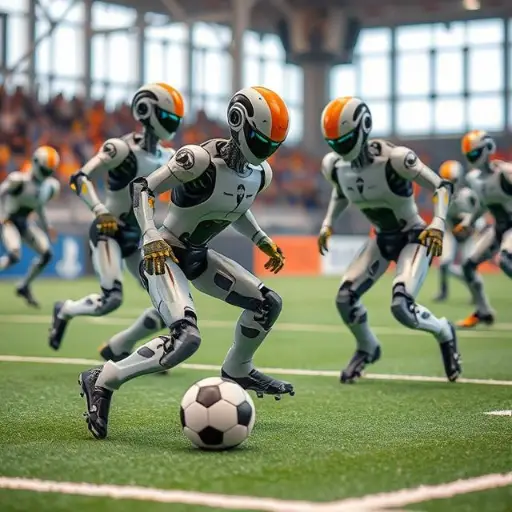
China has officially launched its first humanoid robot football league, the RoBoLeague, which kicked off on June 28, 2025, in Beijing. The league features AI-controlled humanoid robots competing in fully autonomous 3-on-3 soccer matches, with the first match between teams developed by Tsinghua University and China Agricultural University ending in a 5-3 victory for Tsinghua’s squad.
The robots, provided by Booster Robotics, are roughly equivalent in capability to 5- or 6-year-old children, according to videos posted online. However, unlike human children, these bots play without any human guidance, relying on artificial intelligence to make real-time decisions, from ball tracking to player positioning and goal attempts. The robots’ AI systems are designed to operate without human control, allowing them to recover after being knocked over or falling during play.
The RoBoLeague is part of a broader national push to accelerate advances in humanoid robotics and AI, with the goal of creating robots that can work in various industries, including warehouses, elder care, and the military. China sees humanoid robots as a key sector in its race for global tech dominance, with the domestic humanoid robot market expected to grow to 870 billion yuan (roughly $120 billion) by 2030.
While the robots are still far from perfect, with frequent falls, awkward tackles, and collisions, the organizers have made adjustments to the rules to accommodate their limitations. Minor collisions are no longer penalized, and robots that become incapacitated can be swapped out. According to the organizers, the bots now generate their own strategies using AI, with no human input.
The RoBoLeague is seen as a crucial step in developing robots that can think and act more like humans, with sports providing the perfect training ground. The league’s organizers believe that competition will help accelerate the development of robots that can balance, react, and coordinate with each other. The robots’ ability to learn from their mistakes and adapt to the game will be a key factor in their development.
The RoBoLeague is not the only example of China’s push for humanoid robotics. In April, Beijing hosted a half-marathon where humanoid robots attempted to run 21 kilometers alongside humans, with one bot finishing the race in 2 hours and 40 minutes. In May, a martial arts match between two humanoid robots took place in Hangzhou, and in August, Beijing will host the World Humanoid Robot Games.
The RoBoLeague is being closely watched by robotics experts and AI researchers, who see it as a potential game-changer in the development of humanoid robots. The league’s focus on fully autonomous matches and the use of AI to control the robots is a significant step forward in the field.
As the RoBoLeague continues to evolve, it will be interesting to see how the robots improve and adapt to the game, paving the way for future advancements in AI and robotics. The league’s success could have significant implications for industries such as manufacturing, healthcare, and transportation, where humanoid robots could potentially be used to improve efficiency and safety.
The RoBoLeague’s organizers are confident that the league will help China become a leader in humanoid robotics and AI, and that the technology developed through the league will have significant economic and social benefits. With the league’s focus on competition and innovation, it is likely that the robots will continue to improve and adapt, paving the way for a future where humans and robots work together to achieve great things.




 The Tower Post