Estonian Prime Minister Calls for International Action Against Alleged Use of Chemical Weapons
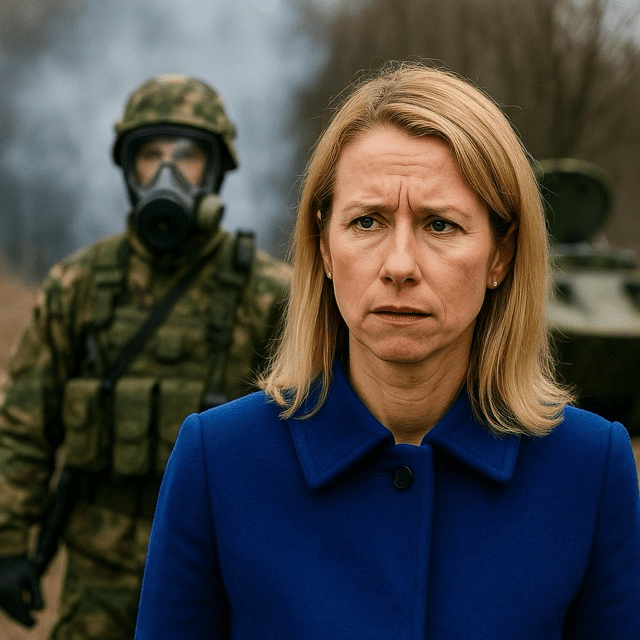
Tallinn – In a forceful address to the European Parliament on July 16, 2025, Estonian Prime Minister Kaja Kallas accused Russian forces of deploying chemical weapons in ongoing assaults against Ukrainian positions. Kallas cited evidence from frontline units and international monitoring bodies, asserting that agents such as chlorine and organophosphates have been used indiscriminately, causing civilian casualties and widespread fear in liberated territories.
According to Kallas, the first reported incidents occurred in late May, when Ukrainian troops in the Kherson region encountered pungent odors and patches of yellow-green gas drifting across defensive lines. “This is not conventional warfare,” Kallas declared, “but a blatant violation of the Chemical Weapons Convention, which Russia ratified in 1997. We cannot stand by as prohibited munitions threaten innocent lives.”
The Estonian leader presented satellite imagery, victim testimonies, and declassified intercepts to bolster her claims. One video clip, shown during her speech, depicted soldiers retreating from a swathe of mist that left several troops with respiratory distress and skin burns. Hospitals in nearby Kharkiv and Zaporizhzhia have reported a surge in patients exhibiting symptoms consistent with chemical exposure.
Kallas called on European Union member states to levy targeted sanctions against Russian military-industrial firms suspected of producing banned agents. She also urged the activation of Article 42 of the Treaty on the Functioning of the European Union, which allows for collective defense measures in response to security threats on the continent. “If we fail to act now, we embolden authoritarian aggression and undermine the rules-based order,” she asserted.
Ukraine’s Ministry of Defense has welcomed the Estonian Prime Minister’s initiative. In a statement, Kyiv’s military spokesman, Colonel Serhiy Movchan, confirmed that Ukrainian forensic teams are working alongside Organization for the Prohibition of Chemical Weapons (OPCW) inspectors to collect soil and biomedical samples. “Our joint mission aims to establish irrefutable proof,” Movchan said. “Accountability must follow atrocity.”
However, Russia’s foreign ministry has vehemently denied the allegations. In Moscow, spokeswoman Maria Zakharova dismissed the claims as “hypocrisy and propaganda,” accusing Kiev and its allies of staging staged provocations to sway international opinion. “Russia remains committed to all arms-control treaties,” Zakharova insisted. “Such baseless accusations only deepen the conflict.”
International reactions have been swift. NATO Secretary General Jens Stoltenberg described any use of chemical weapons as “abhorrent and unacceptable,” reaffirming the alliance’s pledge to defend member states and support partners under attack. Meanwhile, UN Secretary-General António Guterres announced plans to convene an emergency session of the UN Security Council to discuss the matter, though he warned that Russia’s veto power could stymie decisive action.
Experts say the stakes could not be higher. Dr. Anna Friedrich, a chemical weapons specialist at the Stockholm International Peace Research Institute, noted that chlorine shells have a history of auxiliary use in conflicts but organophosphate nerve agents represent a far more chilling escalation. “We may be witnessing a dangerous precedent,” Friedrich cautioned. “The international community must demonstrate zero tolerance if it expects compliance with humanitarian law.”
As frontline conditions in eastern Ukraine remain volatile, the world watches closely. Kaja Kallas’s impassioned plea underscores a growing hunger among Western leaders for tangible responses to Russia’s aggression. Whether sanctions, legal proceedings at the International Criminal Court, or new defense commitments, the coming weeks will test the unity and resolve of the transatlantic community.


 The Tower Post