July 2025 political update: Bayrou’s minority government fights on as Macron mulls fresh gambles
Paris – A year after President Emmanuel Macron shocked Europe by dissolving the National Assembly and triggering snap elections, France remains trapped in the political purgatory those ballots produced. The hung parliament that emerged in July 2024 has since toppled one prime minister, Michel Barnier; elevated another, veteran centrist François Bayrou; and forced Macron into a daily struggle for survival with a legislature he cannot control. Twelve months on, nothing – and everything – has changed.
Bayrou survived his first no‑confidence vote in January 2025 when only 131 lawmakers backed an attempt by the far‑left France Unbowed (LFI) to unseat him, far short of the 288 needed. The centre‑left Socialists withheld their support, extracting promises to reopen the fiercely contested 2023 pension reform and rethink spending cuts that had roiled the streets. Yet the reprieve proved temporary: on 24 June the Socialists tabled their own censure motion after pension talks with unions collapsed, accusing the government of bad faith. The far‑right National Rally (RN) again declined to join the left, calculating that chaos would damage its poll surge less than an early election.
With the censure unlikely to pass, Bayrou turned to his next existential test: the 2026 budget. On 18 July he unveiled a €44 billion deficit‑reduction plan built on a freeze of most non‑defence spending, the suppression of two public holidays and a new “solidarity” tax targeting high earners. He must now convince the Socialists to abstain rather than topple him when he inevitably invokes article 49‑3 to ram the bill through the Assembly in the autumn. Failure would trigger yet another battle for Matignon – or tempt Macron to pull the nuclear lever of a fresh dissolution.
The president regained the constitutional power to do just that on 7 July, the first anniversary of last year’s election. According to multiple insiders quoted by *Politico*, Macron remains publicly dismissive of the idea yet privately intrigued by the gamble of a second snap vote that could either break the deadlock or propel the RN to within striking distance of the Élysée. “Dissolution is his last real weapon,” confided former president François Hollande, one of several voices urging caution.
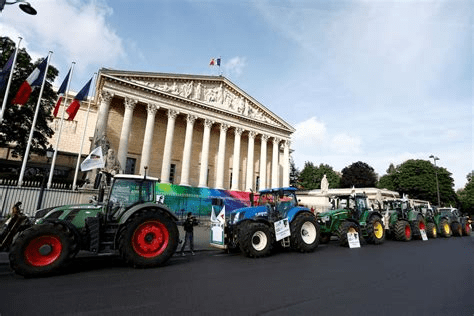
Public patience is wearing thin. On 21 July a petition against a controversial pro‑farmers bill – championed by conservatives and defended by the government – smashed the parliamentary record with 1.3 million signatures, forcing an autumn debate and adding to Bayrou’s headaches. The draft law would re‑authorise the pesticide acetamiprid, loosen rules on large livestock facilities and ease irrigation permits. Environmentalists call it a threat to bees and a symbol of a government deaf to climate worries; farm unions say it is vital for competitiveness.
The policy gridlock has had economic repercussions. Ratings agencies warn that France’s debt trajectory is incompatible with EU fiscal rules unless spending is curbed. Business confidence surveys show investment plans on hold pending clarity over tax and labour laws. Strikes remain a looming menace: the hard‑line CGT union wants a repeat of last year’s refinery blockades unless wages track inflation and the pension age rollback is clarified.
Meanwhile, the political map continues to fragment. The left‑wing New Popular Front (NFP) coalition, which holds the largest single bloc in the Assembly, is struggling to stay united over NATO funding and immigration. The RN is recalibrating its rhetoric to appear a government‑in‑waiting, with Jordan Bardella – not Marine Le Pen – positioning himself as a fiscally responsible alternative. Centrist Ensemble MPs complain they are “hostages” to whichever opposition flank feels most aggrieved on a given bill.
Against that backdrop Macron is searching for legacy projects that do not require parliamentary votes: the green re‑industrialisation plan launched in April, a high‑level Gaza ceasefire conference at the Élysée, and an Olympic‑year tourism offensive designed to keep the post‑Paris 2024 bounce alive. Yet all risk being overshadowed if the Assembly implodes once more.
Key facts – July 2025
Government status: Minority coalition (Ensemble + moderate Republicans) led by PM François Bayrou since 13 Dec 2024.
Parliamentary arithmetic: 245 seats needed for a majority; largest blocs – New Popular Front (168), Ensemble (150), National Rally (132).
Upcoming flashpoints: Budget bill (deadlines: 1 Oct cabinet adoption, Article 49‑3 expected), potential no‑confidence vote (earliest 10 Oct), petition‑triggered farm‑bill debate (late September).
Snap‑election threshold: Macron can dissolve parliament at will now that one year has passed since the last vote.
Economic backdrop: Deficit 5.4 % of GDP; target 3 % by 2029; unions weigh autumn strikes over wage indexation.
For now, France inches toward the summer recess with a premier pleading for Socialist abstentions, a president weighing high‑stakes options, and an electorate bracing for another roller‑coaster rentrée. The Fifth Republic has weathered crises before, but few as drawn‑out and volatile as the tableau unfolding in July 2025.



 The Tower Post