San Francisco start-up asserts chrysopoeia could be realized through nuclear fusion technology
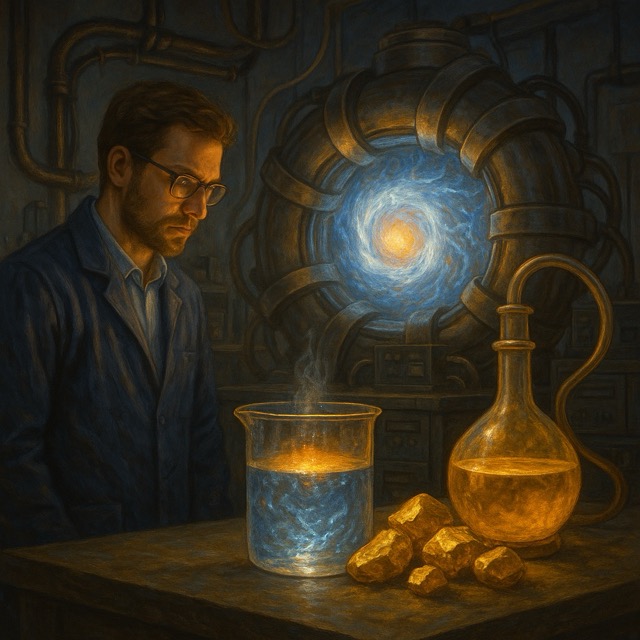
In a startling announcement that blurs the line between ancient legend and cutting-edge science, Marathon Fusion, a San Francisco-based start-up specializing in nuclear fusion power, has declared that it has solved the age-old problem of chrysopoeia—turning base metals into gold. According to company representatives, their novel fusion reactor design can transmute mercury into gold through targeted nuclear reactions, effectively achieving what alchemists sought for centuries.
The pursuit of alchemy dates back millennia, with philosophers and mystics chasing the elusive ‘philosopher’s stone’ believed to convert lead and other metals into the precious metal. While modern chemistry dismissed these ideas as fanciful, the advent of nuclear physics opened theoretical pathways for elemental transmutation. Marathon Fusion claims to have bridged theory and practice by harnessing fusion processes to alter atomic nuclei.
Marathon Fusion’s technology centers on a compact tokamak reactor, where hydrogen isotopes undergo fusion under extreme temperatures and pressures. Engineers at the start-up modified the device to introduce controlled quantities of mercury isotopes into the plasma chamber. By calibrating neutron flux—high-energy neutrons produced during fusion—they assert that mercury nuclei capture neutrons and subsequently decay into gold isotopes via beta decay.
In a private demonstration earlier this month, company scientists displayed small quantities of metallic gold extracted from reactor byproducts. The gold was verified by independent materials analysts, according to Marathon Fusion’s co-founder and chief scientific officer. “We are witnessing a fundamental shift,” he said. “Not only can we generate virtually limitless clean energy, but we can also fabricate valuable elements on demand.”
Despite the company’s bold claims, experts urge caution. Dr. Elena Martinez, a nuclear chemist at the University of Chicago, noted that neutron capture processes are well understood, but scaling them with the required precision is notoriously difficult. “In principle, any element can be transmuted in a nuclear reactor,” she explained. “The challenge lies in efficiency and cost. Producing gold this way is energy-intensive and currently far more expensive than market prices.”
Marathon Fusion counters that their proprietary reactor design achieves unprecedented neutron economy, reducing energy consumption by recycling byproducts and optimizing plasma confinement. Company documents suggest that for every gram of gold produced, the reactor expends less kilowatt-hours than traditional gold mining and refining operations. If accurate, this could redefine the economics of both energy and precious metals.
Industry observers have also raised ethical and economic implications. Gold’s value has traditionally hinged on its scarcity and stability. Should fusion-based alchemy become practical, it could flood markets with newly minted gold, crashing prices and upending entire sectors—from jewelry to central bank reserves. Marathon Fusion executives acknowledge these concerns and have proposed working with regulators to manage output and monitor market impacts.
Beyond gold, the start-up envisions broader applications of fusion transmutation. By adjusting neutron flux and target materials, they suggest the reactor could produce rare earth elements vital for electronics, or medical isotopes used in cancer treatment. This versatility has attracted interest from investors and government agencies looking to secure strategic materials without relying on traditional mining.
Marathon Fusion’s announcement comes amid renewed global focus on fusion energy. Recent breakthroughs—such as net-positive energy yields at major research labs—have invigorated private ventures. However, no fusion reactor has yet reached commercial deployment. Marathon Fusion’s dual promise of energy and elemental production sets it apart but also raises the bar for its rivals.
As Marathon Fusion prepares to open a pilot facility later this year, the scientific community watches with a mix of enthusiasm and skepticism. If proven at scale, their approach could rewrite the playbook for resource production and solidify fusion’s role as humanity’s ultimate alchemical tool. For now, the world can only wait to see if this modern-day alchemy will stand the test of rigorous peer review and commercial viability.



 The Tower Post