European leaders meet Japanese PM Shigeru Ishiba before pivotal discussions with Chinese President Xi Jinping
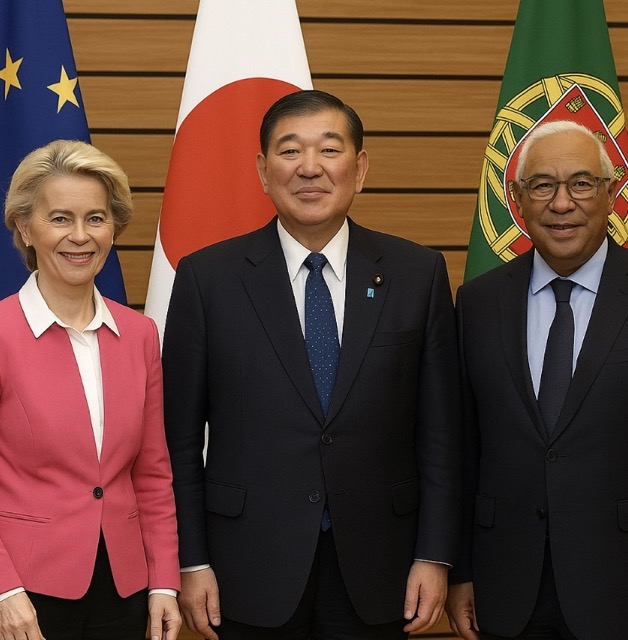
European Commission President Ursula von der Leyen and Portuguese Prime Minister António Costa have begun a significant diplomatic tour in Asia, initiating their agenda in Tokyo by meeting Japanese Prime Minister Shigeru Ishiba. Following their discussions in Japan, the EU leaders are set to travel to China for crucial talks with President Xi Jinping, marking a strategic push by the EU to bolster economic and political ties in Asia.
The visit comes at a crucial juncture, as the EU seeks to diversify partnerships amidst growing geopolitical tensions and economic uncertainty triggered by global conflicts and strained relations with key trading partners. In Tokyo, discussions with Prime Minister Ishiba centered around deepening trade relations, joint commitments to climate initiatives, and enhancing digital cooperation. Analysts see this as an important reaffirmation of the EU’s strategic partnership with Japan, which has become increasingly critical in counterbalancing China’s growing regional influence.
“The partnership between the EU and Japan is not just economic, but deeply strategic,” said Ursula von der Leyen in her opening remarks during the Tokyo meeting. “We are aligned on key global challenges, from climate change to maintaining a rules-based international order.”
Prime Minister Ishiba echoed these sentiments, emphasizing Japan’s intention to expand economic cooperation and strategic coordination with Europe. “Japan sees the EU as a vital partner in addressing global challenges. Our unity sends a strong message in support of peace, security, and sustainable development,” he stated.
Following their time in Japan, von der Leyen and Costa are scheduled to head to Beijing, where discussions are expected to address thornier issues, including trade imbalances, human rights concerns, and mutual efforts to combat climate change. The talks in Beijing are anticipated to be significantly more challenging, as the EU aims to delicately balance criticism of China’s domestic policies while seeking stronger economic ties.
Portuguese Prime Minister António Costa underscored the EU’s desire for constructive engagement: “Our objective in China is clear: we want meaningful dialogue that leads to mutual benefits. We believe in engaging openly and clearly on matters of agreement and disagreement.”
China remains the EU’s largest trade partner, and analysts argue that despite political friction, a functional relationship remains indispensable for Europe’s economic stability. European leaders are expected to emphasize cooperation on climate initiatives and trade facilitation, while gently pushing Beijing to reconsider policies criticized by international human rights groups.
The EU delegation’s visit is seen as a crucial step in navigating the complexities of Asian geopolitics. Experts believe that maintaining constructive yet assertive relationships with both Tokyo and Beijing is key to Europe’s long-term economic and strategic interests in the region.
“This trip underscores Europe’s ambition to play a more active global role, especially in regions crucial to its economic future,” noted Dr. Lena Fischer, a geopolitical expert from the European Institute for Asian Studies. “Striking a balance between cooperation and principled assertiveness will be vital.”
The outcomes of these meetings will likely set the tone for the EU’s broader Asia strategy in the coming years, influencing both economic policy and geopolitical alignment far beyond Brussels, Tokyo, and Beijing.

 The Tower Post