New U.S. tariffs on Japan raise alarms across global markets, as Europe weighs deploying its unprecedented anti-coercion trade weapon.
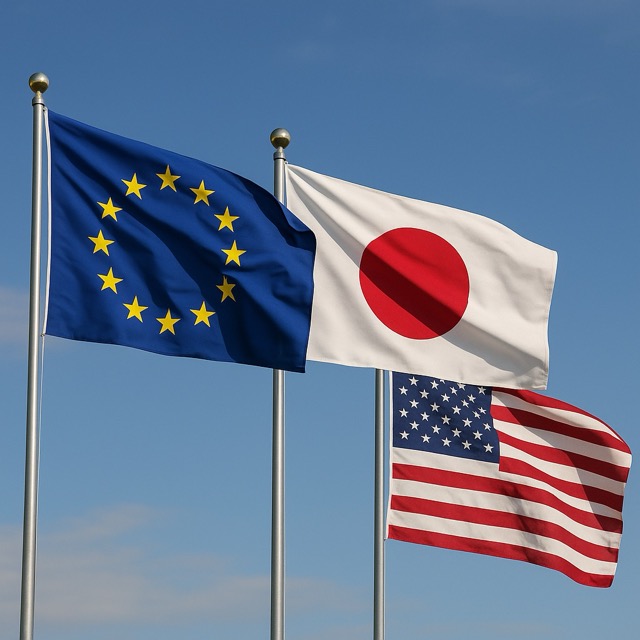
In a bold escalation of trade policy, former President Donald Trump’s administration has imposed increased tariffs on Japan, marking a striking turn in economic relations with one of America’s closest allies. Japan, the largest economy yet to strike a deal under the administration’s restructured trade framework, is now at the center of a geopolitical contest that threatens to reshape global alliances.
Washington insiders suggest the move is intended to send a clear message to America’s partners: failure to meet the administration’s August 1 deadline for bilateral trade alignment will come with consequences. The Trump campaign has revived a familiar strategy—leveraging tariffs to enforce trade objectives—with Japan now symbolizing the price of hesitation.
For Tokyo, the timing is delicate. With an economy still rebounding from deflationary pressures and a soft yen, the additional levies could impact exports of automobiles, electronics, and heavy machinery—pillars of Japan’s industrial base. While Japanese diplomats express a desire to avoid confrontation, they remain cautious about being seen as capitulating under pressure.
European capitals are watching the developments with growing unease. The EU has so far resisted making concessions but faces internal division over how to respond. France and Germany have advocated a stronger approach, urging the European Commission to prepare for countermeasures if the U.S. hardens its stance. Their target: the newly approved anti-coercion instrument, a powerful trade policy tool designed to counter economic threats from third countries.
This so-called ‘trade bazooka’ would allow the EU to restrict U.S. firms from bidding on public tenders, suspend intellectual property protections, and enforce tariffs on strategic sectors. Though never used, its activation could mark a watershed in transatlantic relations, pushing the EU into unprecedented legal and economic terrain.
According to a senior Brussels official speaking on condition of anonymity, ‘The Japanese case confirms what we feared: these tariffs are not temporary leverage—they are structural tools of coercion. If we do not act decisively, we risk eroding the EU’s sovereignty in global trade.’
U.S. corporate interests have already raised concerns. Several American multinational firms, heavily reliant on EU procurement and IP protections, are lobbying Congress and the White House to de-escalate. Privately, industry leaders warn of a ‘lose-lose scenario’ in which both sides harden positions, leading to prolonged trade instability and inflationary pressure.
Meanwhile, diplomatic channels remain active. A trilateral economic summit between the U.S., Japan, and EU officials—tentatively scheduled for late July—aims to defuse tensions. Yet insiders acknowledge that if no tangible framework is reached before August 1, the standoff could spiral.
Financial markets have already begun to react. The Nikkei 225 dipped sharply on news of the tariffs, while European indices showed volatility amid investor fears of a trade war. Analysts at Morgan Stanley and ING have revised growth projections for Q3, factoring in potential retaliatory measures.
‘This is a defining moment for global trade governance,’ said Maria Grunwald, senior fellow at the Global Trade Institute. ‘We are witnessing a realignment of alliances where coercion and resistance are overtaking cooperation and multilateralism.’
While President Trump’s base applauds the tough-on-trade posture, critics argue that it risks undermining decades of postwar economic diplomacy. As election season heats up, the tariffs play to domestic narratives but complicate America’s global leadership.
What remains to be seen is whether the EU will move beyond rhetoric and activate the anti-coercion mechanism—a step fraught with legal and political risks. But with Japan under pressure and Europe drawing its lines, the world could be entering a new chapter of economic brinkmanship, where diplomacy yields to deterrence.
As the clock ticks toward the August deadline, trade officials across three continents are caught in a high-stakes game that could redefine 21st-century commerce. Whether this ends in resolution or rupture may depend on what happens behind closed doors in the coming days.




 The Tower Post