French president to meet Chancellor Friedrich Merz amid growing discord on Europe’s flagship defense initiative
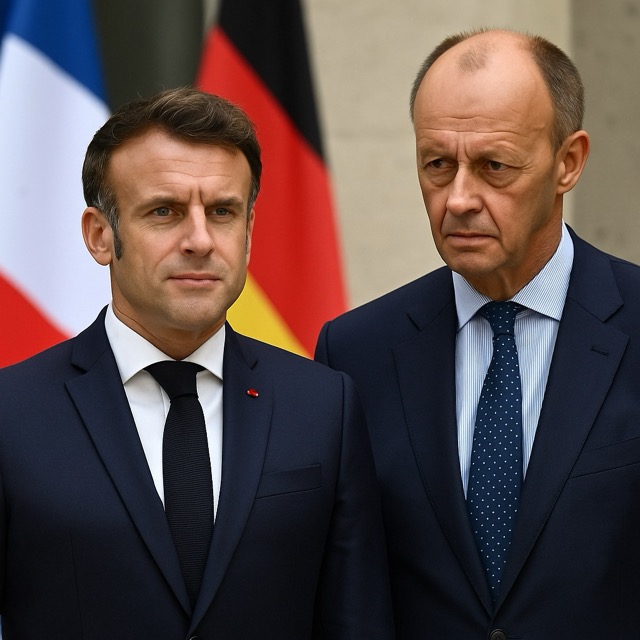
BERLIN, Germany – French President Emmanuel Macron is in Berlin today for a crucial meeting with German Chancellor Friedrich Merz aimed at defusing rising tensions over the Future Combat Air System (FCAS), the ambitious Franco-German-Spanish next-generation fighter jet initiative.
The visit comes at a critical juncture for European defense cooperation. Disagreements over industrial leadership, cost-sharing, and technology transfer have strained relations between the two key EU powers. Macron and Merz are expected to discuss how to realign their nations’ commitments and ensure the project remains on track.
The FCAS program, launched in 2017, is intended to replace France’s Rafale and Germany’s Eurofighter jets by 2040. It has long been touted as a symbol of European strategic autonomy and defense integration. However, recent disputes over the role of industrial champions — particularly France’s Dassault Aviation and Germany’s Airbus — have caused delays and mutual distrust.
Sources close to the negotiations say France has expressed frustration over what it perceives as Germany’s overreach and lack of clarity in defense procurement priorities. Meanwhile, German officials argue that French demands have slowed the process and disregarded German industrial contributions.
This week’s bilateral talks will focus on creating a compromise that satisfies both nations while preserving the trilateral partnership with Spain. Analysts say that without a reset in relations, the FCAS project could lose momentum or splinter entirely, undermining European ambitions for collective defense independence.
‘Europe’s credibility in defense hinges on cooperation between Paris and Berlin,’ said Clara Hennig, a defense analyst at the European Security Institute. ‘If Macron and Merz fail to find common ground, it could jeopardize the continent’s ability to build and deploy critical next-gen military technologies.’
The meeting also occurs against the backdrop of broader geopolitical pressures, including growing uncertainty over NATO’s long-term cohesion and fears of renewed Russian aggression in Eastern Europe. These factors underscore the urgency of bolstering EU-led defense capabilities.
Beyond FCAS, Macron and Merz are also expected to discuss wider bilateral cooperation in energy, economic competitiveness, and climate policy. However, defense remains the focal point of this visit, with both leaders under pressure to demonstrate unity and strategic foresight.
The two-day summit will include working groups, a joint press conference, and a visit to a German aerospace facility involved in the FCAS supply chain. Observers will be watching closely for signs of compromise, particularly around intellectual property rights and technology-sharing agreements.
For Macron, the stakes are high as he faces domestic scrutiny over France’s defense spending and European leadership. For Merz, navigating Germany’s political landscape — marked by coalition friction and a growing defense budget — presents its own challenges.
Ultimately, the success or failure of this meeting could shape the trajectory not just of FCAS, but of broader European defense cooperation in an increasingly multipolar world.




 The Tower Post