A New Understanding of Gravity’s Role in Space Exploration
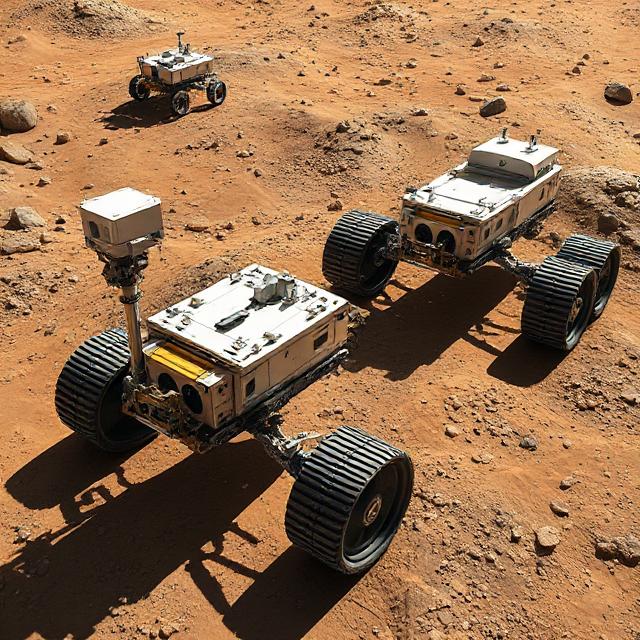
A team of engineers at the University of Wisconsin-Madison has made a groundbreaking discovery that could revolutionize the way we test and navigate robotic space rovers. By using computer simulations, they have uncovered a critical flaw in the current testing method, which has led to a better understanding of how rovers behave in low-gravity environments.
According to the researchers, the traditional method of testing rovers on Earth, which involves creating a prototype that is a sixth of the actual rover’s mass, has been overly optimistic. This approach overlooks the significant difference in gravity between Earth and the moon, which affects the way sand and gravel behave under a rover’s wheels.
The team, led by Professor Dan Negrut, used Project Chrono, an open-source physics simulation engine, to analyze the mobility of the VIPER rover, which was planned for a lunar mission. Their simulations revealed that Earth’s gravity pulls down on sand much more strongly than the gravity on Mars or the moon, making it more rigid and supportive.
“This is a simple yet crucial insight,” Negrut said. “We need to consider not only the gravitational pull on the rover but also the effect of gravity on the sand to get a better picture of how the rover will perform on the moon.”
The researchers’ discovery has significant implications for future space missions. It highlights the importance of using physics-based simulations to analyze rover mobility on granular soil, which can help prevent costly and time-consuming rescues of stuck rovers. According to Negrut, the traditional testing method has led to a series of stuck rovers, including the Mars rover Spirit, which remained permanently stuck in 2009.
“The Spirit rover was a billion-dollar mission that got stuck in soft sand on Mars,” Negrut explained. “If we had known about the importance of gravity’s effect on the sand, we might have been able to prevent that.”
The benefits of this research extend beyond space exploration, as Project Chrono has been used by hundreds of organizations to better understand complex mechanical systems on Earth. The software is free and publicly available, and the UW-Madison team continues to innovate and enhance it to stay relevant.
“This is a remarkable example of how university research can have a significant impact on real-world engineering challenges,” Negrut said. “We’re proud of what we’ve accomplished, and we’re excited to see how our work will continue to evolve and improve.”
The team’s findings, published in the Journal of Field Robotics, have already sparked interest from NASA and other space agencies. The researchers’ discovery is seen as a major breakthrough in the field of robotics and space exploration, and it is expected to have a significant impact on future missions to the moon and beyond.
“We’re not just talking about the moon,” Negrut said. “We’re talking about Mars, and other destinations that we’re planning to explore in the coming years. This research is a critical step forward in our understanding of how to navigate and operate in these environments.”
The University of Wisconsin-Madison team is continuing to work on Project Chrono, with the goal of making it an even more powerful tool for researchers and engineers around the world. The software is already being used by organizations such as the U.S. Army and the European Space Agency, and the team is confident that it will continue to be a valuable resource for years to come.




 The Tower Post