Italian Prime Minister’s bid to negotiate with Donald Trump falters as U.S. sets terms that strain European unity
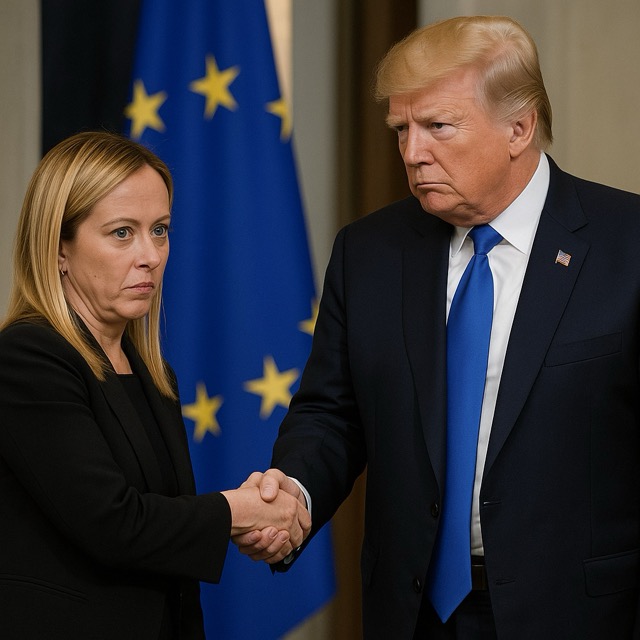
On April 2025, Italian Prime Minister Giorgia Meloni arrived in Washington D.C. determined to serve as a bridge between the European Union and former U.S. President Donald Trump. Her goal was to negotiate fairer terms on a looming trade agreement and to temper Trump’s hardline economic stance toward Europe. However, after hours of talks at the White House, Meloni emerged empty-handed, marking what many analysts have termed her darkest day in office.
Trump’s administration announced a new trade pact imposing a 15% baseline tariff on most European exports, despite heavy lobbying from EU member states to avoid punitive measures. While Chancellor Friedrich Merz of Germany and Meloni publicly endorsed the deal as a necessary compromise, behind the scenes Meloni was unable to secure any significant concessions for Italy or the wider EU bloc.
Inside the Oval Office, Trump reportedly rebuffed Meloni’s appeals for exemptions on key Italian exports such as machinery and luxury goods. According to participants, Trump emphasized that “America must come first,” signaling that friendship alone would not alter his economic agenda.
The fallout was swift. In Brussels, EU Commission President Ursula von der Leyen described the agreement as “suboptimal” but the only available option to avert a full-scale trade war. French Prime Minister François Bayrou went further, calling the deal a “dark day” for Europe, accusing member states of ceding too much ground to U.S. demands.
Meloni’s political capital took an immediate hit at home. Opposition leaders criticized her for failing to protect Italian industries, while pro-European factions questioned her judgment in aligning too closely with Trump. “This was an exercise in diplomatic overreach,” stated the Democratic Party.
Economists warned that the new tariffs could slow Italy’s export-driven recovery post-pandemic, with the country’s machinery and automotive sectors particularly vulnerable. The Italian National Institute of Statistics projected a potential 0.3% GDP contraction if no further relief is secured.
Domestically, Meloni’s approval ratings dipped by four points in the immediate aftermath, according to a poll by Eurobarometer. Analysts noted that her standing among moderate conservatives weakened the most, as her gamble to curry favor in Washington failed to yield tangible benefits at home.
In the European Parliament, calls grew for a more unified transatlantic strategy. MEPs from France and Germany urged Meloni to coordinate closely with Brussels rather than striking bilateral deals that risked undermining EU solidarity. “No member state should negotiate alone,” remarked German MEPs.
As Trump prepares to host further summits with EU leaders, Meloni faces a critical choice: rebuild trust among her European peers or pursue conditional rapprochement with Washington. Her next moves will likely define her legacy as either a unifier or a divider within the Western alliance.
For now, Meloni’s dark day in Washington stands as a cautionary tale of overconfidence in high-stakes diplomacy, reminding leaders that bridging divergent interests requires more than personal rapport—it demands concrete commitments that align with collective goals.


 The Tower Post