Olivier Guersent urges Brussels to resist political pressure and uphold market principles as he steps down
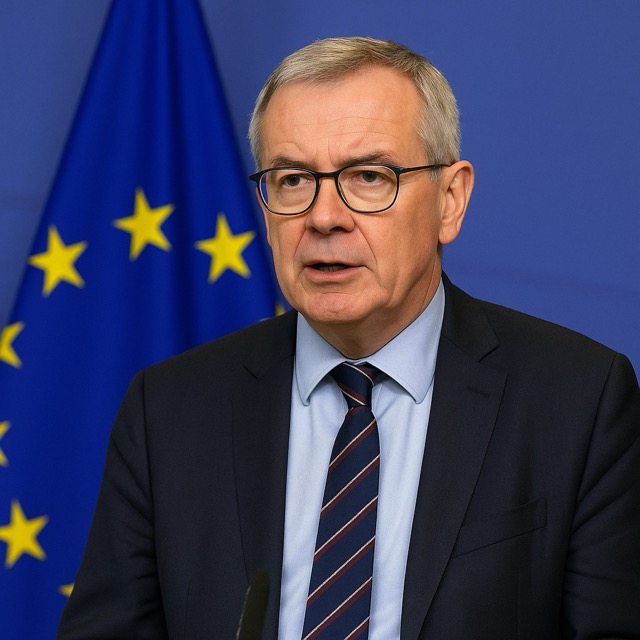
As the European Union grapples with intensifying global competition, the bloc’s outgoing Director-General for Competition, Olivier Guersent, has issued a stark warning: the EU must stay faithful to its antitrust principles and resist the urge to bend rules under political pressure aimed at creating “European champions.”
Guersent, who is stepping down after five years in one of Brussels’ most influential roles, challenged the notion that bigger companies are inherently better positioned to compete with corporate behemoths from the United States and China. “Big is not always beautiful,” he stated pointedly, in remarks that underscore the EU’s internal struggle between market integrity and industrial ambition.
Defying the ‘Champion’ Narrative
The term “European champions” has gained currency among some policymakers who argue that the EU needs to foster continental giants capable of standing up to U.S. tech firms and Chinese state-backed conglomerates. However, Guersent warned that such a policy approach risks undermining the bloc’s founding principles of fair competition and rule-based governance.
“Picking winners and artificially propping them up with state aid undermines both market fairness and innovation,” Guersent said. He pointed to historical cases where mergers were blocked or heavily scrutinized for their potential to stifle competition, noting that relaxing standards now would send the wrong message.
The Pressure Within
Guersent’s comments are a response to growing internal pressure, particularly from countries like France and Germany, which have lobbied for looser merger rules. Their goal: to enable the creation of industrial giants in sectors ranging from technology to green energy. The 2019 prohibition of the Siemens-Alstom rail merger — blocked due to competition concerns — sparked sharp criticism from Paris and Berlin, and led to calls for reforming EU antitrust rules.
But Guersent maintained that regulatory independence is essential. “Our job is not to help companies become bigger just to wave the European flag,” he noted. “Our mandate is to ensure that markets remain competitive and that consumers benefit from fair prices and more innovation.”
A Legacy of Market Integrity
During his tenure, Guersent presided over some of the EU’s most high-profile competition cases, including actions against tech giants like Google and Amazon. He also helped modernize the EU’s approach to state aid, especially in the wake of the COVID-19 pandemic and the war in Ukraine, while trying to balance crisis measures with long-term market discipline.
His departure raises questions about how firmly the Commission will hold its line under his successor. Some fear a shift toward more politically driven competition policy, especially with industrial policy taking center stage in the EU’s economic strategy.
Europe at a Crossroads
The debate over competition and industrial consolidation speaks to broader questions about Europe’s global role. Can the EU preserve its internal market principles while adapting to a more aggressive international landscape? Guersent’s parting advice suggests caution.
“We must build competitiveness on innovation, not on protectionism,” he said. “The rules are not an obstacle — they are the reason Europe has a fair and functioning market.”
As the EU gears up for a new political cycle, the challenge will be to ensure that short-term political goals do not erode the long-term architecture of the Union’s economic governance. For now, Olivier Guersent’s warning stands as a reminder of what’s at stake when policy is shaped by pressure rather than principle.


 The Tower Post